Not Available


Society for Pediatric Radiology – Poster Archive
Final ID: Poster #: CR-037
A Unique Case of Cytarabine Neurotoxicity in the Treatment of Acute Myeloid Leukemia
Purpose or Case Report: Neurotoxicity is a potential adverse effect from chemotherapeutic agents such as cytarabine (Ara-C) when treating children with acute myeloid leukemia (AML). Ara-C is an antineoplastic antimetabolite that, once activated by deoxycytidine kinase, mimics and competes with natural nucleosides to disrupt DNA synthesis. If present in the nervous system, Ara-C can lead to central nervous system (CNS) (e.g., cerebellar syndrome, encephalopathy, necrotizing leukoencephalopathy, and seizures), spinal cord (e.g., myelopathy), and peripheral nerve (e.g., sensory polyneuropathy) symptoms. Although neuroradiologic literature is sparse and variable, unique cases of neurotoxicity continue to occur.
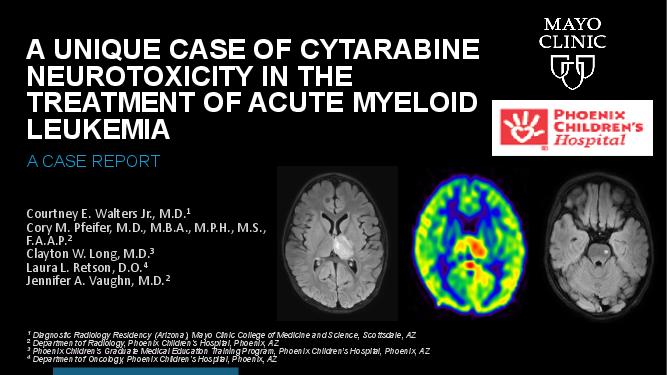
We present a 2-year-old male with a history of recurrent infections, leg pain at night, weight loss, and night sweats, who was diagnosed with AML and started on an intrathecal (IT) and intravenous chemotherapy regimen (i.e., Ara-C, daunorubicin, etoposide, and methotrexate). During Intensification II, several days after receiving their fourth dose of IT Ara-C and two weeks after IT methotrexate, the patient developed acute altered mental status, ataxia, and right-sided weakness. MRI brain with and without intravenous contrast showed an atypical expansile region of abnormal signal in the left thalamus, brainstem, temporal lobe, and cerebellum with asymmetric increased perfusion, patchy enhancement, and patchy faint restricted diffusion. There were also patchy non-enhancing areas of white matter signal abnormality and tiny microhemorrhage. MRI of the spine, MR angiography and venography of the brain were normal. The patient’s symptoms gradually improved without intervention with mild residual right-sided weakness and ataxia. Infectious workup was negative. A follow-up brain MRI showed a reduction in the size of lesions. Ara-C was held from the subsequent chemotherapy regimen and symptoms did not recur. This case highlights a unique thalamic and brainstem finding not previously reported in the literature for Ara-C neurotoxicity in pediatric AML. Of the other chemotherapeutic agents, methotrexate (MTX)-induced neurotoxicity remains on the differential, however, such radiographic features are typically characterized by MTX-related leukoencephalopathy of the central white matter, which we do not see in this case. Altogether, Ara-C neurotoxicity should remain on the differential for children with neurological symptoms after receiving this agent.
Methods & Materials:
Results:
Conclusions:
We present a 2-year-old male with a history of recurrent infections, leg pain at night, weight loss, and night sweats, who was diagnosed with AML and started on an intrathecal (IT) and intravenous chemotherapy regimen (i.e., Ara-C, daunorubicin, etoposide, and methotrexate). During Intensification II, several days after receiving their fourth dose of IT Ara-C and two weeks after IT methotrexate, the patient developed acute altered mental status, ataxia, and right-sided weakness. MRI brain with and without intravenous contrast showed an atypical expansile region of abnormal signal in the left thalamus, brainstem, temporal lobe, and cerebellum with asymmetric increased perfusion, patchy enhancement, and patchy faint restricted diffusion. There were also patchy non-enhancing areas of white matter signal abnormality and tiny microhemorrhage. MRI of the spine, MR angiography and venography of the brain were normal. The patient’s symptoms gradually improved without intervention with mild residual right-sided weakness and ataxia. Infectious workup was negative. A follow-up brain MRI showed a reduction in the size of lesions. Ara-C was held from the subsequent chemotherapy regimen and symptoms did not recur. This case highlights a unique thalamic and brainstem finding not previously reported in the literature for Ara-C neurotoxicity in pediatric AML. Of the other chemotherapeutic agents, methotrexate (MTX)-induced neurotoxicity remains on the differential, however, such radiographic features are typically characterized by MTX-related leukoencephalopathy of the central white matter, which we do not see in this case. Altogether, Ara-C neurotoxicity should remain on the differential for children with neurological symptoms after receiving this agent.
Methods & Materials:
Results:
Conclusions:
More abstracts on this topic:
Typical Appearances on Pre-operative MRI of Histology Proven Epilepsy Provoking Brain Tumors at a UK Tertiary Paediatric Epilepsy Surgery Centre: An Educational Review
Paradise Charles, Ellenbogen Jonathan, Kurzbuch Arthur, Avula Shivaram
2-Year Neurocognitive Outcome Prediction of Hypoxic Ischemic Encephalopathy in Neonates with Brain MRIsBao Rina, Grant Ellen, Ou Yangming
Poster____CR-037.pdf
Comments
We encourage you to join the discussion by posting your comments and questions below.
Presenters will be notified of your post so that they can respond as appropriate.
This discussion platform is provided to foster engagement, and stimulate conversation and knowledge sharing.
Please click here to review the full terms and conditions for engaging in the discussion, including refraining from product promotion and non-constructive feedback.
You have to be authorized to post a comment. Please,
Login or
Signup.
Please note that this is a separate login, not connected with your credentials used for the SPR main website.
Rate this abstract
(Maximum characters: 500)
Please note that this is a separate login, not connected with your credentials used for the SPR main website.