Not Available


Society for Pediatric Radiology – Poster Archive
Final ID: Poster #: EDU-071
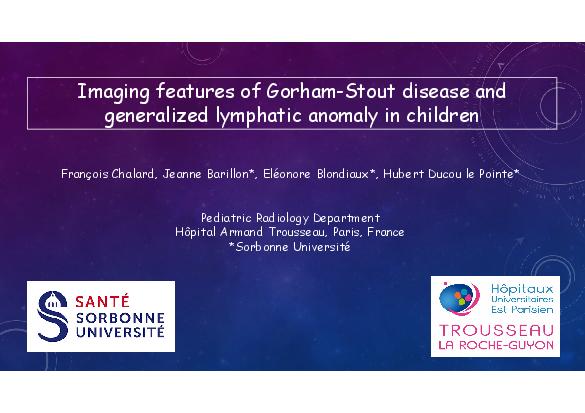
Imaging Features of Gorham-Stout Disease and Generalized Lymphatic Anomaly in Children
Purpose or Case Report: Complex lymphatic anomalies (CLA) are extremely rare sporadic diseases of genetic origin, primarily affecting children, adolescents, and young adults. According to the International Society for the Study of Vascular Anomalies classification, there are five types of CLA: generalized lymphatic anomaly (GLA), Gorham-Stout disease (GSD), kaposiform lymphangiomatosis, central conducting lymphatic anomaly, and generalized lymphatic dysplasia. These lymphatic malformations are characterized by lymphatic proliferation under the influence of vascular endothelial growth factor.
Our educational exhibit aims to briefly review the pathophysiology of CLA and illustrate the spectrum of lesions in 14 patients, including 9 with GSD and 5 with GLA.
Gorham-Stout disease, also known as vanishing bone disease, is characterized by progressive bone destruction with cortical resorption. The primary lesion, a punched-out osteolysis, typically extends from the initially affected bone to nearby bones and is more frequently observed in the axial skeleton (skull, spine, ribs, pelvic bones and shoulder girdle). It can progress rapidly and sometimes stabilize spontaneously. There is usually no periosteal reaction or bone reconstruction. Patients can present with pain (particularly in case of pathological fracture and vertebral collapse), chronic lymphedema, lower limb length discrepancy, assymetric girth, scoliosis/kyphosis, pericardial ou pleural effusion, and rarely meningitis due to a breach of the skull base.
Generalized lymphatic anomaly, formely called lymphangiomatosis, is a diffuse or multicentric disease involving soft tissues, bones, spleen, liver, intestine, lungs, mediastinum, and skin. Thoracic involvment may result in respiratory failure due to chylous pleural effusion, interstitial syndrome or restrictive syndrome related to spinal deformity, as well as pericardial effusion. Bone lesions primarily involve the axial skeleton, as in GSD. Compared with GSD, bone lesions may be multifocal, bone destruction is less severe and fracture are uncommon. Abdominal involvement includes splenic lesions, retroperitoneal mass, ascites, intestinal hemorrhage, and lymphorrhea.
Methods & Materials:
Results:
Conclusions:
Our educational exhibit aims to briefly review the pathophysiology of CLA and illustrate the spectrum of lesions in 14 patients, including 9 with GSD and 5 with GLA.
Gorham-Stout disease, also known as vanishing bone disease, is characterized by progressive bone destruction with cortical resorption. The primary lesion, a punched-out osteolysis, typically extends from the initially affected bone to nearby bones and is more frequently observed in the axial skeleton (skull, spine, ribs, pelvic bones and shoulder girdle). It can progress rapidly and sometimes stabilize spontaneously. There is usually no periosteal reaction or bone reconstruction. Patients can present with pain (particularly in case of pathological fracture and vertebral collapse), chronic lymphedema, lower limb length discrepancy, assymetric girth, scoliosis/kyphosis, pericardial ou pleural effusion, and rarely meningitis due to a breach of the skull base.
Generalized lymphatic anomaly, formely called lymphangiomatosis, is a diffuse or multicentric disease involving soft tissues, bones, spleen, liver, intestine, lungs, mediastinum, and skin. Thoracic involvment may result in respiratory failure due to chylous pleural effusion, interstitial syndrome or restrictive syndrome related to spinal deformity, as well as pericardial effusion. Bone lesions primarily involve the axial skeleton, as in GSD. Compared with GSD, bone lesions may be multifocal, bone destruction is less severe and fracture are uncommon. Abdominal involvement includes splenic lesions, retroperitoneal mass, ascites, intestinal hemorrhage, and lymphorrhea.
Methods & Materials:
Results:
Conclusions:
More abstracts on this topic:
Anillos Vasculares: Serie de Casos y Aproximación para el Reporte Radiológico
Ugas Charcape Carlos, Matos-rojas Irma, Sanchez-navarro Juan P., Fernández-ochoa Diana, Conilla-arispe José M.
Acquired non-traumatic temporal bone lesions in children: A Pictorial Review.Karuppiah Viswanathan Ashok Mithra, Wilson Nagwa
Poster____EDU-071.pdf
Comments
We encourage you to join the discussion by posting your comments and questions below.
Presenters will be notified of your post so that they can respond as appropriate.
This discussion platform is provided to foster engagement, and stimulate conversation and knowledge sharing.
Please click here to review the full terms and conditions for engaging in the discussion, including refraining from product promotion and non-constructive feedback.
You have to be authorized to post a comment. Please,
Login or
Signup.
Please note that this is a separate login, not connected with your credentials used for the SPR main website.
Rate this abstract
(Maximum characters: 500)
Please note that this is a separate login, not connected with your credentials used for the SPR main website.