Not Available


Society for Pediatric Radiology – Poster Archive
Final ID: Poster #: CR-010
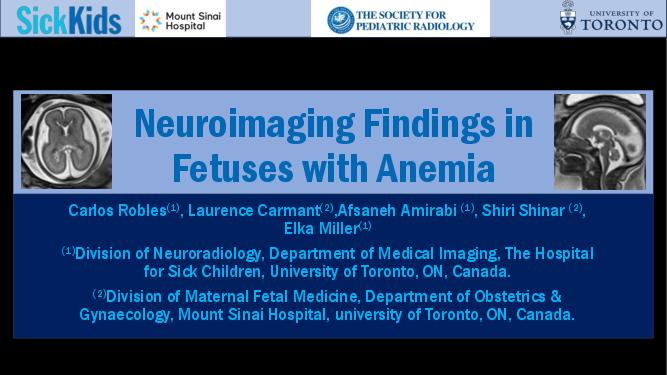
Neuroimaging Findings in Fetuses with Anemia
Purpose or Case Report: Fetal anemia is a severe condition with diverse etiologies that can lead to complications, including fetal hypoxia, heart failure, hydrops fetalis and intrauterine fetal death if left untreated. In severe cases, intrauterine transfusion (IUT) is a life-saving intervention. The impact of fetal anemia on brain development remains unclear. This study aimed to evaluate neuroimaging findings in fetuses diagnosed with anemia using magnetic resonance imaging (MRI).
Methods & Materials: We performed a retrospective cohort study including all fetuses diagnosed with fetal anemia on fetal blood sampling in a single tertiary center between October 2010 and October 2024. Pregnancies were included if they underwent fetal brain MRI following anemia diagnosis. Data collected included maternal and fetal characteristics, IUT details, and prenatal MRI findings.
Results: 55 pregnancies met inclusion criteria with 27 monochorionic twin and 28 singleton pregnancies for a total of 82 fetuses. Among 61 surviving fetuses (21 demised), the mean gestational age at MRI was 27.7 weeks and the average pre-transfusion hemoglobin level was 4.6 g/dL. Eleven cases met criteria for severe anemia (Hb <3.0 g/dL). MRI revealed at least one brain abnormality in 65.5% of cases. MRI findings included: 1. Hemorrhagic lesions (n=16, 26.2%), ranging from germinal matrix to parenchymal hemorrhages, with intraventricular hemorrhage in 18% of cases. 2. Restricted diffusion (n=11, 18.0%), consistent with ischemic changes of the brain parenchyma, with 90.9% being multifocal. 3. Corpus callosum anomalies (n=6, 9.8%), characterized by thinning and foreshortening. 4. Ventriculomegaly (n=3, 4.9%), with one case secondary to obstructive hydrocephalus. 5. Cerebral edema (n=2, 3.3%). 6. Encephalomalacia (n=2, 3.3%), indicative of prior injury.
Conclusions: CNS abnormalities are common in fetuses with anemia, with 65.5% showing at least one brain abnormality. The most common CNS findings include hemorrhagic and ischemic lesions. Our findings emphasize the importance of fetal MRI in the management of fetal anemia to guide clinical decisions and monitor brain injury following intrauterine transfusion.
Methods & Materials: We performed a retrospective cohort study including all fetuses diagnosed with fetal anemia on fetal blood sampling in a single tertiary center between October 2010 and October 2024. Pregnancies were included if they underwent fetal brain MRI following anemia diagnosis. Data collected included maternal and fetal characteristics, IUT details, and prenatal MRI findings.
Results: 55 pregnancies met inclusion criteria with 27 monochorionic twin and 28 singleton pregnancies for a total of 82 fetuses. Among 61 surviving fetuses (21 demised), the mean gestational age at MRI was 27.7 weeks and the average pre-transfusion hemoglobin level was 4.6 g/dL. Eleven cases met criteria for severe anemia (Hb <3.0 g/dL). MRI revealed at least one brain abnormality in 65.5% of cases. MRI findings included: 1. Hemorrhagic lesions (n=16, 26.2%), ranging from germinal matrix to parenchymal hemorrhages, with intraventricular hemorrhage in 18% of cases. 2. Restricted diffusion (n=11, 18.0%), consistent with ischemic changes of the brain parenchyma, with 90.9% being multifocal. 3. Corpus callosum anomalies (n=6, 9.8%), characterized by thinning and foreshortening. 4. Ventriculomegaly (n=3, 4.9%), with one case secondary to obstructive hydrocephalus. 5. Cerebral edema (n=2, 3.3%). 6. Encephalomalacia (n=2, 3.3%), indicative of prior injury.
Conclusions: CNS abnormalities are common in fetuses with anemia, with 65.5% showing at least one brain abnormality. The most common CNS findings include hemorrhagic and ischemic lesions. Our findings emphasize the importance of fetal MRI in the management of fetal anemia to guide clinical decisions and monitor brain injury following intrauterine transfusion.
More abstracts on this topic:
Spectrum of Midface Anomalies on Fetal MRI
Vansyckel Arielle, Brown Brandon
Fidelity of 3DPrinted patient specific functional brain models from multi sequence MRI and their clinical utility in pediatric epileptic patients with focal lesionsParthasarathy Jayanthi, Gedela Satya, Ostendorf Adam, Pindrik Jonathan, Jones Jeremy, Mcallister Aaron, Selvaraj Bhavani, Long Alexander
Poster____CR-010.pdf
Comments
We encourage you to join the discussion by posting your comments and questions below.
Presenters will be notified of your post so that they can respond as appropriate.
This discussion platform is provided to foster engagement, and stimulate conversation and knowledge sharing.
Please click here to review the full terms and conditions for engaging in the discussion, including refraining from product promotion and non-constructive feedback.
You have to be authorized to post a comment. Please,
Login or
Signup.
Please note that this is a separate login, not connected with your credentials used for the SPR main website.
Rate this abstract
(Maximum characters: 500)
Please note that this is a separate login, not connected with your credentials used for the SPR main website.