Not Available


Society for Pediatric Radiology – Poster Archive
Final ID: Poster #: EDU-015
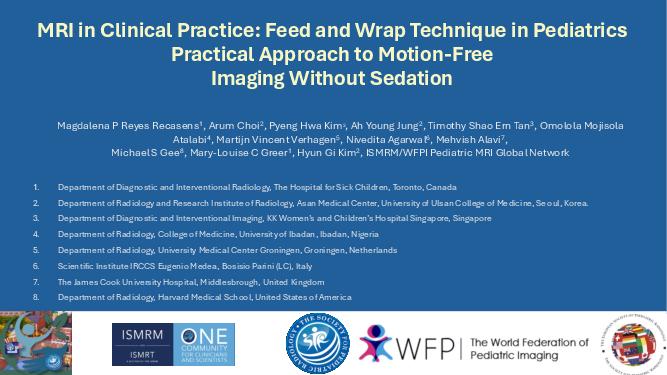
Feed and Wrap Technique in Pediatric MRI Studies: Practical Approach to Motion-Free Imaging Without Sedation
Purpose or Case Report: Magnetic resonance imaging (MRI) is one of the essential diagnostic tools in pediatric radiology, however, obtaining high-quality, motion-free images in infants remains a challenge. Sedation or general anesthesia is often required to minimize motion artifacts, but these carry potential risks, including respiratory depression, prolonged recovery, and potential neurodevelopmental effects with repeated exposure. In addition, access to general anesthesia for MRI examinations is often limited, particularly in underdeveloped countries. The feed and wrap technique offers a safe, effective, and non-pharmacologic alternative to sedation for imaging infants, particularly those under 3 months of age.
This educational poster will review the principles and practical steps of the feed and wrap technique, including patient selection, preparation, feeding strategies, swaddling methods, and optimization of MRI protocols. We will discuss environmental adjustments, such as room temperature control, noise reduction, and use of immobilization aids, to maximize success rates. In addition, we will present case examples demonstrating typical applications across brain, spine, and abdominal MRI studies, highlighting common pitfalls and troubleshooting strategies when motion or incomplete sequences occur.
We will also compare diagnostic image quality between feed and wrap studies and sedated studies, review success rates reported in the literature, and provide practical guidance for implementing this technique in both community and tertiary care settings.
Radiologists, technologists, and pediatricians play a key role in promoting safe, patient-centered imaging practices. Familiarity with the feed and wrap technique empowers pediatric imaging teams to reduce sedation rates, improve workflow efficiency and safety, while maintaining diagnostic quality in MRI examinations for the young patients.
Methods & Materials:
Results:
Conclusions:
This educational poster will review the principles and practical steps of the feed and wrap technique, including patient selection, preparation, feeding strategies, swaddling methods, and optimization of MRI protocols. We will discuss environmental adjustments, such as room temperature control, noise reduction, and use of immobilization aids, to maximize success rates. In addition, we will present case examples demonstrating typical applications across brain, spine, and abdominal MRI studies, highlighting common pitfalls and troubleshooting strategies when motion or incomplete sequences occur.
We will also compare diagnostic image quality between feed and wrap studies and sedated studies, review success rates reported in the literature, and provide practical guidance for implementing this technique in both community and tertiary care settings.
Radiologists, technologists, and pediatricians play a key role in promoting safe, patient-centered imaging practices. Familiarity with the feed and wrap technique empowers pediatric imaging teams to reduce sedation rates, improve workflow efficiency and safety, while maintaining diagnostic quality in MRI examinations for the young patients.
Methods & Materials:
Results:
Conclusions:
More abstracts on this topic:
Effects of an MRI Try Without Program on Patient Access and Image Quality
Rudder Barbra, Easley Sara, Robinson Amie, Nielsen David
Reliable Projectile Hazard Reduction in MRIBushur Katherine
Poster____EDU-015.pdf
Comments
We encourage you to join the discussion by posting your comments and questions below.
Presenters will be notified of your post so that they can respond as appropriate.
This discussion platform is provided to foster engagement, and stimulate conversation and knowledge sharing.
Please click here to review the full terms and conditions for engaging in the discussion, including refraining from product promotion and non-constructive feedback.
You have to be authorized to post a comment. Please,
Login or
Signup.
Please note that this is a separate login, not connected with your credentials used for the SPR main website.
Rate this abstract
(Maximum characters: 500)
Please note that this is a separate login, not connected with your credentials used for the SPR main website.