Not Available


Society for Pediatric Radiology – Poster Archive
Final ID: Poster #: EDU-025
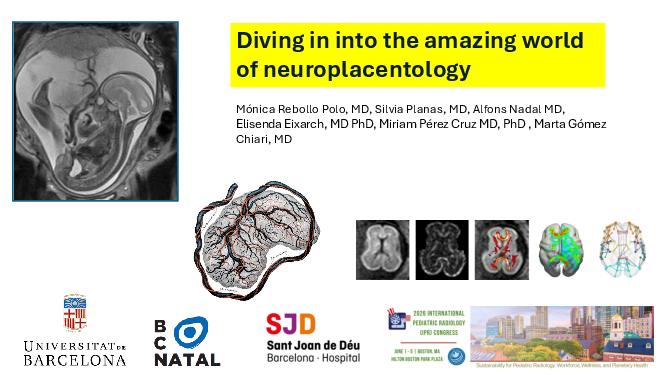
Diving Into the Amazing World of Neuroplacentology
Purpose or Case Report: The growing body of evidence linking placental physiology and brain development has led to the emergence of a new field coined “neuroplacentology” Disease processes affecting the placenta can have a major influence on overall fetal circulatory function and specifically blood flow to the CNS. In addition, the placenta also plays an important role as an endocrine and immune protective organ.
The aim of this review is to describe the main abnormal placental phenotypes according to the 2016 Amsterdam pathological classification and the role of abnormal placenta in neurodevelopmental disorders.
The placenta-mediated mechanisms of perinatal brain injury are varied, ranging from poor protection to hypoxia.
Methods & Materials: New imaging MRI techniques such as IVIM (intravoxel incoherent motion) and T2* mapping are being developed to depict these placental diseases in utero.
Pathological correlation will be provided
Clinical outcomes included are fetal growth restriction, acute and cronic HIE, white matter injury, delayed brain sulcation, stroke and fetal demise
Results: The four major patterns of placental injury are maternal vascular malperfusion, acute chorioamnionitis, villitis of unkonwn etiology and fetal vascular malperfusion. TThe prevalence of one pattern or the other varies according to gestational age at delivery (premature to term). We present an overview of these different phenotypes, with radiopathological correlation and fetal and neonatal clinical outcomes.
Conclusions: Monitoring placental health is important in perinatology in different conditions (FGR, CMV, with fetal congenital heart disease, preterm delivery, neonatal encephalopathy) because placental pathology may be an early biomarker for adverse neurodevelopment.
The aim of this review is to describe the main abnormal placental phenotypes according to the 2016 Amsterdam pathological classification and the role of abnormal placenta in neurodevelopmental disorders.
The placenta-mediated mechanisms of perinatal brain injury are varied, ranging from poor protection to hypoxia.
Methods & Materials: New imaging MRI techniques such as IVIM (intravoxel incoherent motion) and T2* mapping are being developed to depict these placental diseases in utero.
Pathological correlation will be provided
Clinical outcomes included are fetal growth restriction, acute and cronic HIE, white matter injury, delayed brain sulcation, stroke and fetal demise
Results: The four major patterns of placental injury are maternal vascular malperfusion, acute chorioamnionitis, villitis of unkonwn etiology and fetal vascular malperfusion. TThe prevalence of one pattern or the other varies according to gestational age at delivery (premature to term). We present an overview of these different phenotypes, with radiopathological correlation and fetal and neonatal clinical outcomes.
Conclusions: Monitoring placental health is important in perinatology in different conditions (FGR, CMV, with fetal congenital heart disease, preterm delivery, neonatal encephalopathy) because placental pathology may be an early biomarker for adverse neurodevelopment.
More abstracts on this topic:
Magnetic Resonance Angiography and T2* Mapping of Placenta
Qu Feifei, Qian Zhaoxia, Yadav Brijesh, Romero Roberto, Haacke E., Sun Taotao, Patwardhan Sanjay, Patwardhan Manasi, Jaiman Sunil, Jellal Pavan, Mody Swati, Marin Concha Julio, Jiang Ling
Fetal Cerebral Vascular Malformations: A Systematic MRI Checklist for Accurate Diagnosis and Prognostic EvaluationGómez-chiari Marta, Rebollo Polo Monica, Planells Mariana, San Roman Luis, Eixarch Roca Elisenda, Perez Cruz Miriam, Fons Estupiña Maria Del Carmen, Agut Quijano Thais, Gonzalez Sandoval Lenia, Blasco Sola Gerard
Poster____EDU-025.pdf
Comments
We encourage you to join the discussion by posting your comments and questions below.
Presenters will be notified of your post so that they can respond as appropriate.
This discussion platform is provided to foster engagement, and stimulate conversation and knowledge sharing.
Please click here to review the full terms and conditions for engaging in the discussion, including refraining from product promotion and non-constructive feedback.
You have to be authorized to post a comment. Please,
Login or
Signup.
Please note that this is a separate login, not connected with your credentials used for the SPR main website.
Rate this abstract
(Maximum characters: 500)
Please note that this is a separate login, not connected with your credentials used for the SPR main website.