Not Available


Society for Pediatric Radiology – Poster Archive
Final ID: Poster #: EDU-005
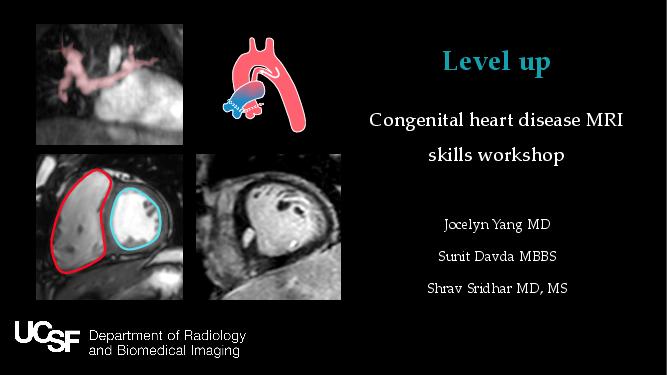
Congenital Heart Disease: An MRI Skills Workshop
Purpose or Case Report:
Cardiovascular MRI is an invaluable tool used for clinical decision-making in children with congenital heart disease (CHD). The variable anatomy and physiology encountered in this cohort of patients challenges radiologists to integrate morphologic understanding with precise imaging metrics that drive management. Developing a solid understanding of common workflows used in CHD MRI can make the imager more confident and efficient in conducting the appropriate assessments in each case. This exhibit employs a skills-based method designed to make MRI evaluation of CHD more approachable, structured, and clinically impactful.
This course is not focused on assessment of any one congenital heart disease nor is it a simple case compendium, but rather, is aimed at teaching specific skills and demonstration of the use of MRI analytical techniques that can be applied to the spectrum of CHD ranging from simple shunts to simple obstructive lesions such as aortic coarctation to complex congenital heart diseases such as double outlet right ventricle. Learners will gain fluency with commonly employed CHD MRI workflows including morphologic characterization, angiography, volumetric analysis, gradient measurement, semilunar valve assessment, atrioventricular valve assessment, collateral flow quantification (systemic arterial, aortopulmonary, and venovenous), shunt quantification, internal consistency analysis, and myocardial tissue characterization. Each workflow will be paired with a sample case(s) that highlights the clinical utility of the associated workflow and addresses pearls and pitfalls associated with each workflow.
Following completion of this educational course, the learner will have gained experience exercising both interpretive and quantitative skills needed to conduct the different workflows that may be required for a particular CHD MRI case he or she encounters, understand when a certain analysis should be considered, and be able to perform quality checks that ensure generation of accurate clinical data to help guide the patient’s management.
Methods & Materials:
Results:
Conclusions:
Cardiovascular MRI is an invaluable tool used for clinical decision-making in children with congenital heart disease (CHD). The variable anatomy and physiology encountered in this cohort of patients challenges radiologists to integrate morphologic understanding with precise imaging metrics that drive management. Developing a solid understanding of common workflows used in CHD MRI can make the imager more confident and efficient in conducting the appropriate assessments in each case. This exhibit employs a skills-based method designed to make MRI evaluation of CHD more approachable, structured, and clinically impactful.
This course is not focused on assessment of any one congenital heart disease nor is it a simple case compendium, but rather, is aimed at teaching specific skills and demonstration of the use of MRI analytical techniques that can be applied to the spectrum of CHD ranging from simple shunts to simple obstructive lesions such as aortic coarctation to complex congenital heart diseases such as double outlet right ventricle. Learners will gain fluency with commonly employed CHD MRI workflows including morphologic characterization, angiography, volumetric analysis, gradient measurement, semilunar valve assessment, atrioventricular valve assessment, collateral flow quantification (systemic arterial, aortopulmonary, and venovenous), shunt quantification, internal consistency analysis, and myocardial tissue characterization. Each workflow will be paired with a sample case(s) that highlights the clinical utility of the associated workflow and addresses pearls and pitfalls associated with each workflow.
Following completion of this educational course, the learner will have gained experience exercising both interpretive and quantitative skills needed to conduct the different workflows that may be required for a particular CHD MRI case he or she encounters, understand when a certain analysis should be considered, and be able to perform quality checks that ensure generation of accurate clinical data to help guide the patient’s management.
Methods & Materials:
Results:
Conclusions:
More abstracts on this topic:
Comparison of Cardiac Magnetic Resonance with Computed Tomography Angiography for Coronary Artery Assessment in Pediatric Patients with Dextro-transposition of the Great Arteries After Arterial Switch Operation
Calderon Kylie, Robinson Joshua, Husain Nazia, Popescu Andrada, Rigsby Cynthia
Eye-maging Features of Leukocoria: Diagnostic Insights into Common Pediatric Ocular PathologiesRao Jhanavi, Thakor Dipakkumar, Schroeder Jason
Poster____EDU-005.pdf
Comments
We encourage you to join the discussion by posting your comments and questions below.
Presenters will be notified of your post so that they can respond as appropriate.
This discussion platform is provided to foster engagement, and stimulate conversation and knowledge sharing.
Please click here to review the full terms and conditions for engaging in the discussion, including refraining from product promotion and non-constructive feedback.
You have to be authorized to post a comment. Please,
Login or
Signup.
Please note that this is a separate login, not connected with your credentials used for the SPR main website.
Rate this abstract
(Maximum characters: 500)
Please note that this is a separate login, not connected with your credentials used for the SPR main website.