Not Available


Society for Pediatric Radiology – Poster Archive
Final ID: Poster #: EDU-113
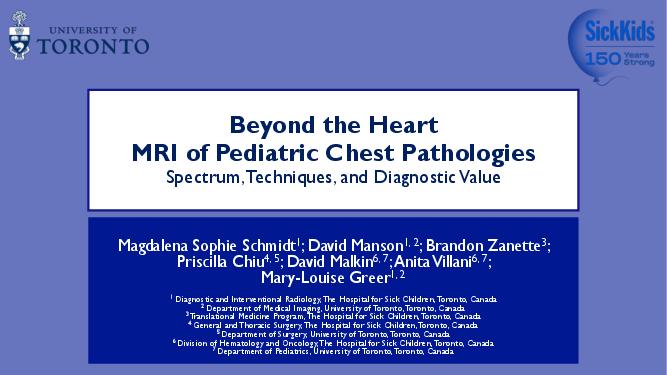
Beyond the Heart: MRI of Pediatric Chest Pathologies – Spectrum, Techniques, and Diagnostic Value
Purpose or Case Report: Magnetic resonance imaging (MRI) has become an increasingly valuable modality for evaluating pediatric chest pathologies beyond cardiac disease. Its diagnostic spectrum now extends to mediastinal, pulmonary, pleural, and chest wall abnormalities. Although traditionally limited by long acquisition times, motion artefacts, and the challenges of lung parenchyma imaging, recent advances such as ultrashort echo time (UTE), and zero echo time (ZTE) sequences have markedly expanded its clinical utility.
This educational poster highlights the applications of MRI across a broad range of pediatric thoracic conditions, including mediastinal masses, congenital lung malformations, pulmonary tumors, infections, inflammatory diseases, and chest wall abnormalities. The mediastinal pathologies are structured according to the standard compartmental classification - prevascular, visceral, and paravertebral - to facilitate a systematic and anatomical approach to interpretation.
Drawing on our institutional experience of primary to quaternary referrals, we will present cases to:
1. Review key MRI techniques applicable to pediatric thoracic imaging, including diffusion-weighted and contrast-enhanced imaging, as well as motion-suppression strategies.
2. Demonstrate MRI findings for mediastinal, pulmonary and chest wall pathologies, focusing on lesion characterization and delineation of relationships to adjacent structures and provide pearls and pitfalls for confident interpretation.
3. Discuss the role of MRI in children, given their heightened tissue sensitivity and increased lifetime risk of radiation-induced malignancy. The advantage is even more significant in patients with cancer predisposition syndromes, in whom cumulative radiation exposure is a major concern.
4. Outline practical workflow aspects, including preparation techniques such as feed-and-sleep imaging and child-life involvement, as well as safety considerations for repeated or contrast-enhanced studies.
5. Compare MRI with CT and radiography, underscoring its diagnostic strengths, limitations, and complementary role in specific clinical scenarios.
6. Provide a structured overview and practical framework to support the use of chest MRI in pediatric imaging.
This educational overview aims to familiarize radiologists with MRI’s current and evolving role in pediatric thoracic imaging, highlight achievable image quality and diagnostic confidence, and encourage broader clinical adoption of radiation-free chest MRI in children.
Methods & Materials:
Results:
Conclusions:
This educational poster highlights the applications of MRI across a broad range of pediatric thoracic conditions, including mediastinal masses, congenital lung malformations, pulmonary tumors, infections, inflammatory diseases, and chest wall abnormalities. The mediastinal pathologies are structured according to the standard compartmental classification - prevascular, visceral, and paravertebral - to facilitate a systematic and anatomical approach to interpretation.
Drawing on our institutional experience of primary to quaternary referrals, we will present cases to:
1. Review key MRI techniques applicable to pediatric thoracic imaging, including diffusion-weighted and contrast-enhanced imaging, as well as motion-suppression strategies.
2. Demonstrate MRI findings for mediastinal, pulmonary and chest wall pathologies, focusing on lesion characterization and delineation of relationships to adjacent structures and provide pearls and pitfalls for confident interpretation.
3. Discuss the role of MRI in children, given their heightened tissue sensitivity and increased lifetime risk of radiation-induced malignancy. The advantage is even more significant in patients with cancer predisposition syndromes, in whom cumulative radiation exposure is a major concern.
4. Outline practical workflow aspects, including preparation techniques such as feed-and-sleep imaging and child-life involvement, as well as safety considerations for repeated or contrast-enhanced studies.
5. Compare MRI with CT and radiography, underscoring its diagnostic strengths, limitations, and complementary role in specific clinical scenarios.
6. Provide a structured overview and practical framework to support the use of chest MRI in pediatric imaging.
This educational overview aims to familiarize radiologists with MRI’s current and evolving role in pediatric thoracic imaging, highlight achievable image quality and diagnostic confidence, and encourage broader clinical adoption of radiation-free chest MRI in children.
Methods & Materials:
Results:
Conclusions:
More abstracts on this topic:
Radiation-Free Pediatric Chest Imaging: A 4D ZTE MRI Protocol Enhanced by Deep Learning
Shoaib Navaira, Gee Michael, Sagar Pallavi, Patrick Lenehan, Rigsby Devyn, Clark Kendall, Gallo Sebastian, Harrington Samantha, De Arcos Jose, Milshteyn Eugene, Victoria Teresa
Respiratory Distress in a Full-term Newborn: Chest X-ray Rules Out the Usual Suspects.Rodriguez Ruiz Felipe, Benscoter Dan, Tiao Gregory, Feng Christina, Hart Catherine, Fleck Robert
Poster____EDU-113.pdf
Comments
We encourage you to join the discussion by posting your comments and questions below.
Presenters will be notified of your post so that they can respond as appropriate.
This discussion platform is provided to foster engagement, and stimulate conversation and knowledge sharing.
Please click here to review the full terms and conditions for engaging in the discussion, including refraining from product promotion and non-constructive feedback.
You have to be authorized to post a comment. Please,
Login or
Signup.
Please note that this is a separate login, not connected with your credentials used for the SPR main website.
Rate this abstract
(Maximum characters: 500)
Please note that this is a separate login, not connected with your credentials used for the SPR main website.