Not Available


Society for Pediatric Radiology – Poster Archive
Final ID: Poster #: EDU-031
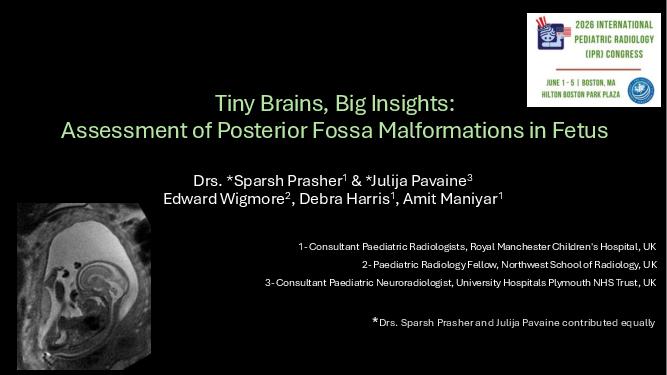
Tiny Brains, Big Insights: Assessment of Posterior Fossa Malformations in the Fetus
Purpose or Case Report: Posterior fossa abnormalities are among the most complex and diagnostically challenging findings on foetal MRI. They encompass a wide spectrum of malformations of the cerebellum, brainstem, and fourth ventricle, with variable prognostic implications. Accurate prenatal characterisation is essential for counselling parents, genetic testing and perinatal planning. In this poster we aim to provide a structured, reproducible framework for evaluating foetal posterior fossa abnormalities. A total of 1,400 foetal brain MRI examinations performed over eight years at a tertiary referral centre have been reviewed, identifying all cases with posterior fossa abnormalities. Images were analysed for vermian morphology, cerebellar hemispheric development, fourth ventricular configuration, brainstem integrity, and associated syndromic features. Posterior fossa abnormalities were stratified into five categories: Cerebellar vermis and fourth ventricle malformations, including the recent insights into Dandy–Walker spectrum, Blake’s pouch cyst, isolated vermian hypoplasia, and mega cisterna magna; Cerebellar hemispheric anomalies, such as unilateral/bilateral hypoplasia and cerebellar dysplasia as well as rhombencephalosynapsis; Midbrain–hindbrain junction disorders, including Joubert syndrome and related disorders, and pontocerebellar hypoplasia; Cystic or acquired lesions, including arachnoid cysts and post-ischemic/post-hemorrhagic cystic changes; Syndromic or complex malformations, including Walker–Warburg spectrum and tubulinopathies. The poster highlights refined Dandy–Walker criteria, including inferior-predominant vermian hypoplasia, enlarged tegmentovermian and fastigial recess angles, and inferolateral displacement of the tela choroidea and choroid plexus, distinguishing it from Blake’s pouch cyst and mega cisterna magna. This review illustrates the full spectrum of fetal posterior fossa abnormalities. Annotated MRI cases, schematic diagrams, and a stepwise diagnostic algorithm are provided to enhance interpretative accuracy, reporting consistency, and prenatal counselling.
Methods & Materials:
Results:
Conclusions:
Methods & Materials:
Results:
Conclusions:
More abstracts on this topic:
Below Deck: The Fetal Posterior fossa in Health and Disease
Whitehead Matthew, Lee Bonmyong
Quantitative Assessment of Contralateral Lung Signal in Fetuses with Left-sided Congenital Diaphragmatic HerniaSantos Luiz, Leite Igor, Fazecas Tatiana, Costa Flavia, Castro Pedro, Daltro Pedro, Werner Heron
Poster____EDU-031.pdf
Comments
We encourage you to join the discussion by posting your comments and questions below.
Presenters will be notified of your post so that they can respond as appropriate.
This discussion platform is provided to foster engagement, and stimulate conversation and knowledge sharing.
Please click here to review the full terms and conditions for engaging in the discussion, including refraining from product promotion and non-constructive feedback.
You have to be authorized to post a comment. Please,
Login or
Signup.
Please note that this is a separate login, not connected with your credentials used for the SPR main website.
Rate this abstract
(Maximum characters: 500)
Please note that this is a separate login, not connected with your credentials used for the SPR main website.