Not Available


Society for Pediatric Radiology – Poster Archive
Final ID: Poster #: EDU-048
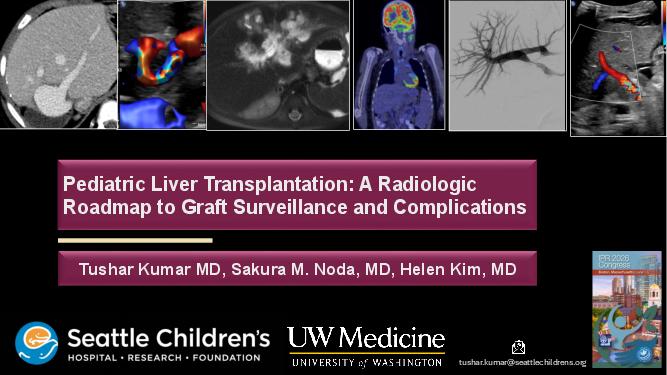
Beyond the Transplant: Imaging the Pediatric Liver Graft and Its Complications
Purpose or Case Report: Pediatric liver transplantation has evolved into a life-saving procedure since the first successful transplant, for biliary atresia, in 1967. In the United States, biliary atresia remains the leading indication, accounting for nearly half of all pediatric liver transplants, with most recipients aged five years or younger. Advances in surgical techniques, particularly the development of split-liver and living-donor transplantation, have significantly improved graft availability and patient survival, achieving one-year survival rates as high as 94%. Despite these advances, post-transplant complications remain common and are broadly categorized as vascular, biliary, infectious, and parenchymal or neoplastic. Vascular complications pose the greatest threat to graft viability. Early postoperative imaging surveillance with grayscale and Doppler ultrasound is vital for timely detection. Normal early postoperative findings include mild perihepatic fluid, subtle vascular narrowing, and heterogeneous parenchymal echotexture. Typical Doppler characteristics include brisk systolic upstroke with continuous diastolic flow in the hepatic artery, monophasic flow in portal vein, and multiphasic or dampened venous waveforms. Hepatic artery thrombosis is the most critical vascular complication, often manifested as tardus-parvus arterial waveforms, and can lead to graft ischemia or failure. Hepatic artery stenosis, occurring most often within the first 100 days, may require prompt endovascular intervention. Portal vein thrombosis or stenosis, though less frequent, can cause portal hypertension with splenomegaly and ascites. Biliary complications, including anastomotic strictures and leaks, affect approximately 12–40% of pediatric recipients, usually within the first three months post-transplant. In the longer term, neoplastic complications such as post-transplant lymphoproliferative disorder occur in up to 2-8%of pediatric liver transplant patients, necessitating vigilant radiologic and clinical follow-up. Ultrasound remains the cornerstone of early and serial postoperative evaluation, given its safety, accessibility, and high sensitivity for vascular and biliary pathology. Rapid identification of complications enables timely intervention, optimizing graft function and long-term survival in pediatric liver transplant recipients.
Methods & Materials:
Results:
Conclusions:
Methods & Materials:
Results:
Conclusions:
More abstracts on this topic:
Thoracic Ultrasound - Say What? A Special Diagnostic Tool in Pediatric Population
Gual Fabiana, Sameshima Yoshino, Otto Debora, Braga Fernanda, Cardoso Mariana, Fernandes-ferreira Rafael, Souza Antonio
Comparison of postmortem ultrasound and X-Ray with autopsy in fetal death: retrospective study of 169 casesProdhomme Olivier, Baud Catherine, Saguintaah Magali, Bolivar Perrin Julie, David Stephanie, Taleb Arrada Ikram, Couture Alain
Poster____EDU-048.pdf
Comments
We encourage you to join the discussion by posting your comments and questions below.
Presenters will be notified of your post so that they can respond as appropriate.
This discussion platform is provided to foster engagement, and stimulate conversation and knowledge sharing.
Please click here to review the full terms and conditions for engaging in the discussion, including refraining from product promotion and non-constructive feedback.
You have to be authorized to post a comment. Please,
Login or
Signup.
Please note that this is a separate login, not connected with your credentials used for the SPR main website.
Rate this abstract
(Maximum characters: 500)
Please note that this is a separate login, not connected with your credentials used for the SPR main website.