Not Available


Society for Pediatric Radiology – Poster Archive
Final ID: Poster #: EDU-040
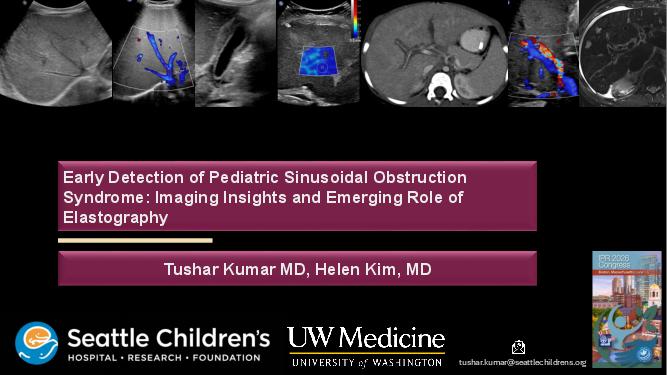
Early Detection of Pediatric SOS/VOD: Imaging Insights and the Emerging Role of Elastography
Purpose or Case Report: Sinusoidal obstruction syndrome (SOS), also known as veno-occlusive disease (VOD), is a potentially life-threatening hepatic complication that occurs primarily following hematopoietic stem cell transplantation (HSCT). It is characterized by obstruction of hepatic sinusoids and venules due to accumulation of cellular debris and red blood cells, leading to impaired hepatic outflow. The incidence in pediatric patients can be as high as 40%, resulting from toxic injury or activation of liver sinusoidal endothelial cells (LSECs). Common etiologic factors include myeloablative conditioning regimens for HSCT, chemotherapeutic agents such as oxaliplatin, and total body irradiation. SOS/VOD is classified into acute (80%, within 21 days post-HSCT) and late-onset forms (20%, beyond 21 days). Histopathologically, late-phase SOS shows peri-sinusoidal fibrosis and hepatocyte atrophy in addition to sinusoidal obstruction. Clinically, the disease manifests with painful hepatomegaly, conjugated hyperbilirubinemia, and rapid weight gain or ascites. While the modified Seattle and Baltimore criteria are traditionally used for adults, the European Society for Blood and Marrow Transplantation (EBMT) 2019 criteria have been specifically developed for the pediatric population, incorporating both clinical and radiologic parameters. Ultrasonography remains the first-line imaging modality, including gray-scale, color Doppler, and spectral analysis. Ultrasound elastography can detect SOS as early as 2–12 days before clinical criteria are met by quantifying increased hepatic stiffness due to portal hypertension; a ≥ 30% rise in stiffness from baseline has demonstrated high sensitivity and specificity. Characteristic sonographic findings include hepatomegaly, gallbladder wall thickening, increased portal vein diameter, ascites, paraumbilical vein visualization with altered flow, reduced portal venous velocity, and elevated hepatic artery resistive index—imaging parameters that are incorporated into the newer Hok-US scoring system (maximum 14 points). Additionally, MR elastography and hepatobiliary MRI using Eovist have shown promise for early, noninvasive detection. Early diagnosis is critical, as severe SOS carries mortality rates up to 80%, and the only approved therapy remains defibrotide, emphasizing the need for vigilant imaging surveillance and prompt management.
Methods & Materials:
Results:
Conclusions:
Methods & Materials:
Results:
Conclusions:
More abstracts on this topic:
Tubular Enteric Duplication Cyst in an Infant: A Radiological Diagnostic Challenge
Ng Evonne, Dawani Anuradha
Malrotation Mimickers in Abdominal Imaging Duodenum InversumZawin Joan, Buyukkaya Ayla
Poster____EDU-040.pdf
Comments
We encourage you to join the discussion by posting your comments and questions below.
Presenters will be notified of your post so that they can respond as appropriate.
This discussion platform is provided to foster engagement, and stimulate conversation and knowledge sharing.
Please click here to review the full terms and conditions for engaging in the discussion, including refraining from product promotion and non-constructive feedback.
You have to be authorized to post a comment. Please,
Login or
Signup.
Please note that this is a separate login, not connected with your credentials used for the SPR main website.
Rate this abstract
(Maximum characters: 500)
Please note that this is a separate login, not connected with your credentials used for the SPR main website.