Not Available


Society for Pediatric Radiology – Poster Archive
Final ID: Poster #: EDU-114
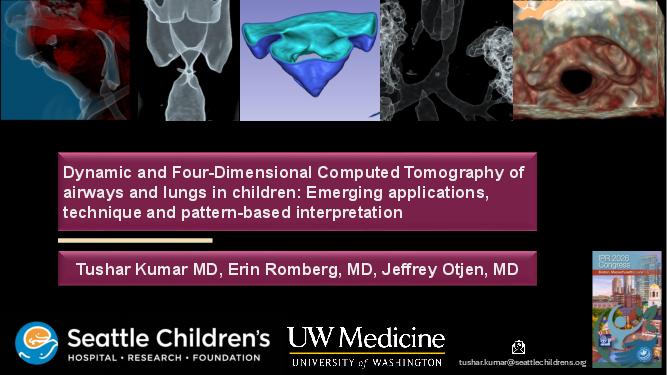
Dynamic and 4D CT of the Pediatric Airways and Lungs: Functional Imaging Beyond Static Anatomy
Purpose or Case Report: Dynamic and four-dimensional computed tomography (4D-CT) of the airways and lungs is an advanced imaging technique designed to identify dynamic pathologies across various levels of airway, including the oropharynx, larynx, trachea, bronchi, and lungs. This modality enables detailed assessment of airway motion and functional abnormalities that are intermittently absent on conventional static imaging. At the oropharyngeal level, Robin sequence (Pierre Robin syndrome) represents congenital anomalies resulting from abnormal development of the first pharyngeal arch, leading to mandibular hypoplasia, failure of normal tongue descent, non-fusion of the palatal shelves, and resultant upper airway obstruction. At the laryngeal level, vocal cord dysfunction is a cause of feeding difficulties and vocal dysfunction in the pediatric population, most frequently resulting from prolonged intubation or iatrogenic injury to the recurrent laryngeal nerve following cardiac surgery. In such cases, dynamic CT serves as a valuable, non-invasive alternative to nasal endoscopy for evaluating glottic motion. Tracheomalacia, defined as excessive expiratory collapse of the tracheal lumen, may be congenital—such as with cystic fibrosis or Mounier-Kuhn syndrome—or acquired secondary to prolonged intubation, chronic or recurrent infections, or idiopathic. Similarly, bronchomalacia refers to the weakening of bronchial cartilage, resulting in airway collapse or significant luminal narrowing during expiration, and may also occur congenitally or as a sequela of chronic inflammation. Dynamic CT of the lung parenchyma can demonstrate areas of air trapping during the expiratory phase, such as with bronchiolitis obliterans secondary to recurrent inflammation, although the precise clinical implications of the CT findings remain undefined. Importantly, many of these entities are challenging to detect on traditional inspiratory and expiratory CT imaging. Dynamic low-dose CT protocols not only enhance diagnostic accuracy by providing real-time functional assessment but also reduce overall radiation exposure by eliminating the need for separate phase acquisitions. This pictorial essay aims to review the spectrum of airway and lung pathologies detectable by dynamic and 4D-CT, emphasizing optimal imaging techniques, interpretative considerations, and risk-based diagnostic strategies relevant to pediatric radiologists.
Methods & Materials:
Results:
Conclusions:
Methods & Materials:
Results:
Conclusions:
More abstracts on this topic:
The Pediatric Upper Airway: Thoroughfares and Road blocks
Whitehead Mark, Whitehead Matthew
Antenatal US and MR features of Congenital High Airway Obstruction Sequence (CHAOS)El Hawari Mohamad, Joshi Akash, Zarchan Adam, Dobbs-desilet Debbie, Ornelas Samuel
Poster____EDU-114.pdf
Comments
We encourage you to join the discussion by posting your comments and questions below.
Presenters will be notified of your post so that they can respond as appropriate.
This discussion platform is provided to foster engagement, and stimulate conversation and knowledge sharing.
Please click here to review the full terms and conditions for engaging in the discussion, including refraining from product promotion and non-constructive feedback.
You have to be authorized to post a comment. Please,
Login or
Signup.
Please note that this is a separate login, not connected with your credentials used for the SPR main website.
Rate this abstract
(Maximum characters: 500)
Please note that this is a separate login, not connected with your credentials used for the SPR main website.