Not Available


Society for Pediatric Radiology – Poster Archive
Final ID: Poster #: EDU-111
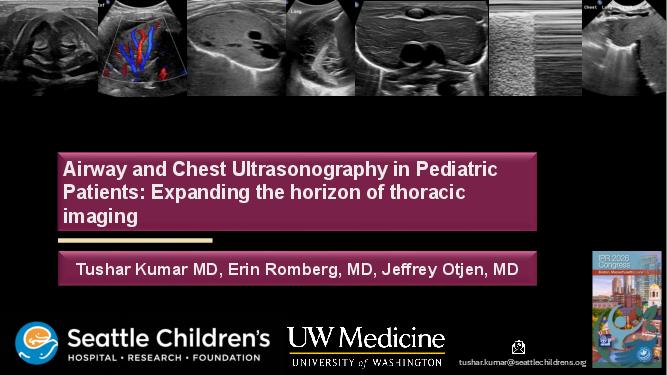
Airway and Chest Ultrasonography in Pediatric Patients: Expanding the Horizon of Thoracic Imaging
Purpose or Case Report: Airway and chest ultrasonography in pediatric patients encompasses a wide spectrum of diagnostic applications, broadly categorized into evaluation of vocal cords, trachea, lungs, diaphragm, and pleura. Vocal cord ultrasonography is increasingly employed for the assessment of vocal cord motion and detection of palsy, particularly in post-intubation or postoperative settings. Tracheal ultrasonography represents an evolving field, currently utilized at our institution for identification of tracheal cartilaginous sleeve—a condition characterized by replacement of segmented tracheal rings with a continuous cartilaginous sheath, often associated with craniosynostosis syndromes. Lung and pleural ultrasonography are well-established techniques increasingly familiar to radiologists and can be useful for evaluating a wide range of pathologies, including consolidation, edema, fibrosis, interstitial pneumonia, lung abscess, pleural effusion, empyema, pneumothorax, and lung tethering. Diaphragmatic ultrasonography is also routinely performed to assess diaphragmatic motion abnormalities such as paralysis, paresis, and eventration—conditions that can be challenging to differentiate by radiograph. A solid understanding of normal lung, pleural, airway, and diaphragmatic anatomy, along with mastery of proper sonographic technique, is essential for accurate diagnosis and interpretation across all levels of radiology practice. As air-filled lungs limit acoustic penetration, radiologists must also recognize common pitfalls and artifacts encountered in pediatric chest ultrasound, including reverberation artefacts, B-lines, M-mode artifacts, and misinterpretation of peritoneal fluid as effusion. Although radiography remains the first-line modality for thoracic evaluation, its utility is constrained by complex, overlapping anatomy of the mediastinum and hidden pulmonary areas. Computed tomography (CT), while diagnostically powerful, exposes young patients to ionizing radiation and should be reserved for cases in which sonography and radiography are inconclusive. This educational exhibit aims to highlight optimal techniques, review relevant anatomy, and illustrate the spectrum of airway and chest pathologies detectable by ultrasound. It further emphasizes recognition of artifacts and comparison with radiographic and CT findings, with goal to promote use of ultrasonography as a radiation-free, readily accessible, and accurate diagnostic tool for pediatric thoracic evaluation.
Methods & Materials:
Results:
Conclusions:
Methods & Materials:
Results:
Conclusions:
More abstracts on this topic:
A Case Study of Orbital Cellulitis in a Patient with Congenital Glaucoma
Riemann Monique, Bell Denise
Bone age assessment with conventional ultrasonography in healthy infants from 24 to 44 months of age.Daneff Monica, Casalis Claudia, Bruno Claudio, Bruno Didier
Poster____EDU-111.pdf
Comments
We encourage you to join the discussion by posting your comments and questions below.
Presenters will be notified of your post so that they can respond as appropriate.
This discussion platform is provided to foster engagement, and stimulate conversation and knowledge sharing.
Please click here to review the full terms and conditions for engaging in the discussion, including refraining from product promotion and non-constructive feedback.
You have to be authorized to post a comment. Please,
Login or
Signup.
Please note that this is a separate login, not connected with your credentials used for the SPR main website.
Rate this abstract
(Maximum characters: 500)
Please note that this is a separate login, not connected with your credentials used for the SPR main website.