Not Available


Society for Pediatric Radiology – Poster Archive
Final ID: Poster #: SCI-011
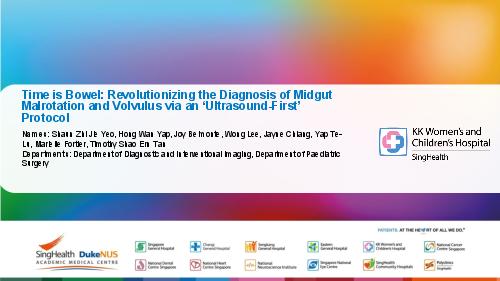
Time is Bowel: Revolutionizing the Diagnosis of Midgut Malrotation and Volvulus via an ‘Ultrasound-First’ Protocol
Purpose or Case Report: To evaluate the impact of an “ultrasound-first” pathway for suspected midgut malrotation/volvulus on diagnostic timeliness and outcomes.
Methods & Materials: An US-first protocol was implemented as a quality improvement initiative, with targeted ultrasound as the first-line investigation and fluoroscopic upper gastrointestinal contrast series (UGC) reserved for inconclusive cases. A pre- and post-implementation study was conducted over six-months. Infants ≤1 year with clinical suspicion of malrotation/volvulus were included. UGC was reserved for inconclusive US findings. Primary outcomes were time-to-diagnosis, radiation dose, and cost. Secondary outcomes included diagnostic accuracy and bowel necrosis rates.
Results: The US-first protocol was applied in 33 infants (20 males; median age 30 days, range 3–395), reducing median time-to-diagnosis from 48 to 18 minutes (p<0.001), eliminating radiation exposure (median: 0.3 mSv in a pre-implementation group of 31 infants), and saving approximately SGD $2,925 per study cycle. Ultrasound achieved 97% diagnostic accuracy with 100% specificity for midgut volvulus, detecting three (9%) cases of malrotation, including two with volvulus. Further UGC was performed in three patients—one due to suboptimal ultrasound and two at surgical discretion. Five critically ill or ventilated infants underwent bedside ultrasound, demonstrating the protocol’s accessibility. Ultrasound also identified alternative diagnoses of pyloric stenosis in two patients. No cases of bowel necrosis occurred.
Conclusions: Our transition to an “US-first” workflow for suspected malrotation is safe, accurate, and time-efficient. It minimizes radiation, accelerates diagnosis, and optimizes resource use. UGC remains a valuable complementary tool when US is inconclusive or non-diagnostic. Successful implementation requires close multidisciplinary collaboration, sustained sonographer training and regular audits.
Methods & Materials: An US-first protocol was implemented as a quality improvement initiative, with targeted ultrasound as the first-line investigation and fluoroscopic upper gastrointestinal contrast series (UGC) reserved for inconclusive cases. A pre- and post-implementation study was conducted over six-months. Infants ≤1 year with clinical suspicion of malrotation/volvulus were included. UGC was reserved for inconclusive US findings. Primary outcomes were time-to-diagnosis, radiation dose, and cost. Secondary outcomes included diagnostic accuracy and bowel necrosis rates.
Results: The US-first protocol was applied in 33 infants (20 males; median age 30 days, range 3–395), reducing median time-to-diagnosis from 48 to 18 minutes (p<0.001), eliminating radiation exposure (median: 0.3 mSv in a pre-implementation group of 31 infants), and saving approximately SGD $2,925 per study cycle. Ultrasound achieved 97% diagnostic accuracy with 100% specificity for midgut volvulus, detecting three (9%) cases of malrotation, including two with volvulus. Further UGC was performed in three patients—one due to suboptimal ultrasound and two at surgical discretion. Five critically ill or ventilated infants underwent bedside ultrasound, demonstrating the protocol’s accessibility. Ultrasound also identified alternative diagnoses of pyloric stenosis in two patients. No cases of bowel necrosis occurred.
Conclusions: Our transition to an “US-first” workflow for suspected malrotation is safe, accurate, and time-efficient. It minimizes radiation, accelerates diagnosis, and optimizes resource use. UGC remains a valuable complementary tool when US is inconclusive or non-diagnostic. Successful implementation requires close multidisciplinary collaboration, sustained sonographer training and regular audits.
More abstracts on this topic:
The Near-Miss Event: How Prompt Intervention Impacted Infants with Unexpected Midgut Volvulus
Berlin Sheila, Guedes Bianca, Vasavada Pauravi, Wien Michael, Albuquerque Pedro, Ugas Carlos
Unusual Presentation of Midgut Volvulus in a 3-Year-Old with Concurrent Acute Portal and Mesenteric Vein ThrombosisPanesar Harsimran, Beekman Alexander, Martin Laura, Armstrong Katherine, Hodes Aaron
Poster____SCI-011.pdf
Comments
We encourage you to join the discussion by posting your comments and questions below.
Presenters will be notified of your post so that they can respond as appropriate.
This discussion platform is provided to foster engagement, and stimulate conversation and knowledge sharing.
Please click here to review the full terms and conditions for engaging in the discussion, including refraining from product promotion and non-constructive feedback.
You have to be authorized to post a comment. Please,
Login or
Signup.
Please note that this is a separate login, not connected with your credentials used for the SPR main website.
Rate this abstract
(Maximum characters: 500)
Please note that this is a separate login, not connected with your credentials used for the SPR main website.