Not Available


Society for Pediatric Radiology – Poster Archive
Final ID: Poster #: EDU-032
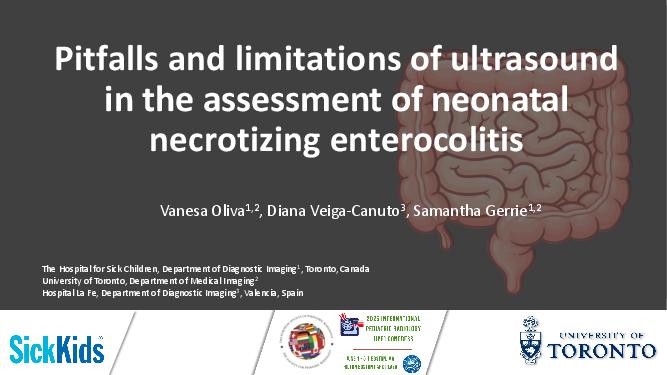
Pitfalls and Limitations of Ultrasound in the Assessment of Neonatal Necrotizing Enterocolitis
Purpose or Case Report: Necrotizing enterocolitis (NEC) is the most common gastrointestinal complication in neonates, particularly in preterm infants. Despite advances in neonatal diagnostic and clinical management, the mortality rate remains high at 20-67%, depending on birth weight and the presence of perforation.
The use of ultrasound (US) in the imaging workup of NEC is well established with important roles in predicting outcome. In particular, Doppler US has shown higher sensitivity and specificity than abdominal radiographs for detecting necrotic bowel. In addition, US is a cost-effective bedside modality that avoids ionizing radiation, making it particularly advantageous in neonates. However, there are several technical challenges that can hinder optimal image acquisition and interpretation including a large amount of intraluminal bowel gas, patients on mechanical ventilation and patients with cardiovascular compromise. We discuss these technical challenges, review common pitfalls and provide a problem-solving approach to improve the diagnostic utility of US in managing these patients.
A large amount of intraluminal bowel gas limits the assessment of the bowel wall making it more difficult to identify intramural gas and changes in bowel perfusion. Increasing transducer pressure can help by displacing intraluminal gas from the field of view, however, in some patients it is not possible due to persistent oxygen desaturations or abdominal discomfort.
Doppler assessment of bowel perfusion can be particularly difficult in mechanically ventilated patients due to motion artifacts caused by transmitted vibration. In patients with low cardiac output and/or receiving vasopressor therapy, color Doppler signal may be difficult to detect due to reduced bowel perfusion; adjusting US parameters may improve bowel wall perfusion assessment.
One imaging pitfall is misinterpreting the presence of pneumatosis as intraluminal gas trapped within the stool or as bowel wall edema. It is important to recognize that intramural gas will not change position with peristalsis, respiratory movement, patient repositioning, or abdominal compression with the transducer.
Recognizing these technical limitations is essential for accurate interpretation, standardized protocol development, and reliable use of US in the management of NEC.
Furthermore, emerging techniques, such as contrast-enhanced US may help address several of these technical limitations, particularly in the evaluation of bowel perfusion.
Methods & Materials:
Results:
Conclusions:
The use of ultrasound (US) in the imaging workup of NEC is well established with important roles in predicting outcome. In particular, Doppler US has shown higher sensitivity and specificity than abdominal radiographs for detecting necrotic bowel. In addition, US is a cost-effective bedside modality that avoids ionizing radiation, making it particularly advantageous in neonates. However, there are several technical challenges that can hinder optimal image acquisition and interpretation including a large amount of intraluminal bowel gas, patients on mechanical ventilation and patients with cardiovascular compromise. We discuss these technical challenges, review common pitfalls and provide a problem-solving approach to improve the diagnostic utility of US in managing these patients.
A large amount of intraluminal bowel gas limits the assessment of the bowel wall making it more difficult to identify intramural gas and changes in bowel perfusion. Increasing transducer pressure can help by displacing intraluminal gas from the field of view, however, in some patients it is not possible due to persistent oxygen desaturations or abdominal discomfort.
Doppler assessment of bowel perfusion can be particularly difficult in mechanically ventilated patients due to motion artifacts caused by transmitted vibration. In patients with low cardiac output and/or receiving vasopressor therapy, color Doppler signal may be difficult to detect due to reduced bowel perfusion; adjusting US parameters may improve bowel wall perfusion assessment.
One imaging pitfall is misinterpreting the presence of pneumatosis as intraluminal gas trapped within the stool or as bowel wall edema. It is important to recognize that intramural gas will not change position with peristalsis, respiratory movement, patient repositioning, or abdominal compression with the transducer.
Recognizing these technical limitations is essential for accurate interpretation, standardized protocol development, and reliable use of US in the management of NEC.
Furthermore, emerging techniques, such as contrast-enhanced US may help address several of these technical limitations, particularly in the evaluation of bowel perfusion.
Methods & Materials:
Results:
Conclusions:
More abstracts on this topic:
Radiographic features of Necrotizing Enterocolitis (NEC), one of the most common gastrointestinal diseases in premature neonates.
Ulikowska Ewelina
Can ultrasound differentiate between right diaphragmatic hernia and eventration?Schold Andrew, Marine Megan, Brown Brandon, Gray Brian, Karmazyn Boaz
Poster____EDU-032.pdf
Comments
We encourage you to join the discussion by posting your comments and questions below.
Presenters will be notified of your post so that they can respond as appropriate.
This discussion platform is provided to foster engagement, and stimulate conversation and knowledge sharing.
Please click here to review the full terms and conditions for engaging in the discussion, including refraining from product promotion and non-constructive feedback.
You have to be authorized to post a comment. Please,
Login or
Signup.
Please note that this is a separate login, not connected with your credentials used for the SPR main website.
Rate this abstract
(Maximum characters: 500)
Please note that this is a separate login, not connected with your credentials used for the SPR main website.