Not Available


Society for Pediatric Radiology – Poster Archive
Final ID: Poster #: SCI-057
Proximal Humerus Fractures in Children: Distribution and Predictors of Surgery
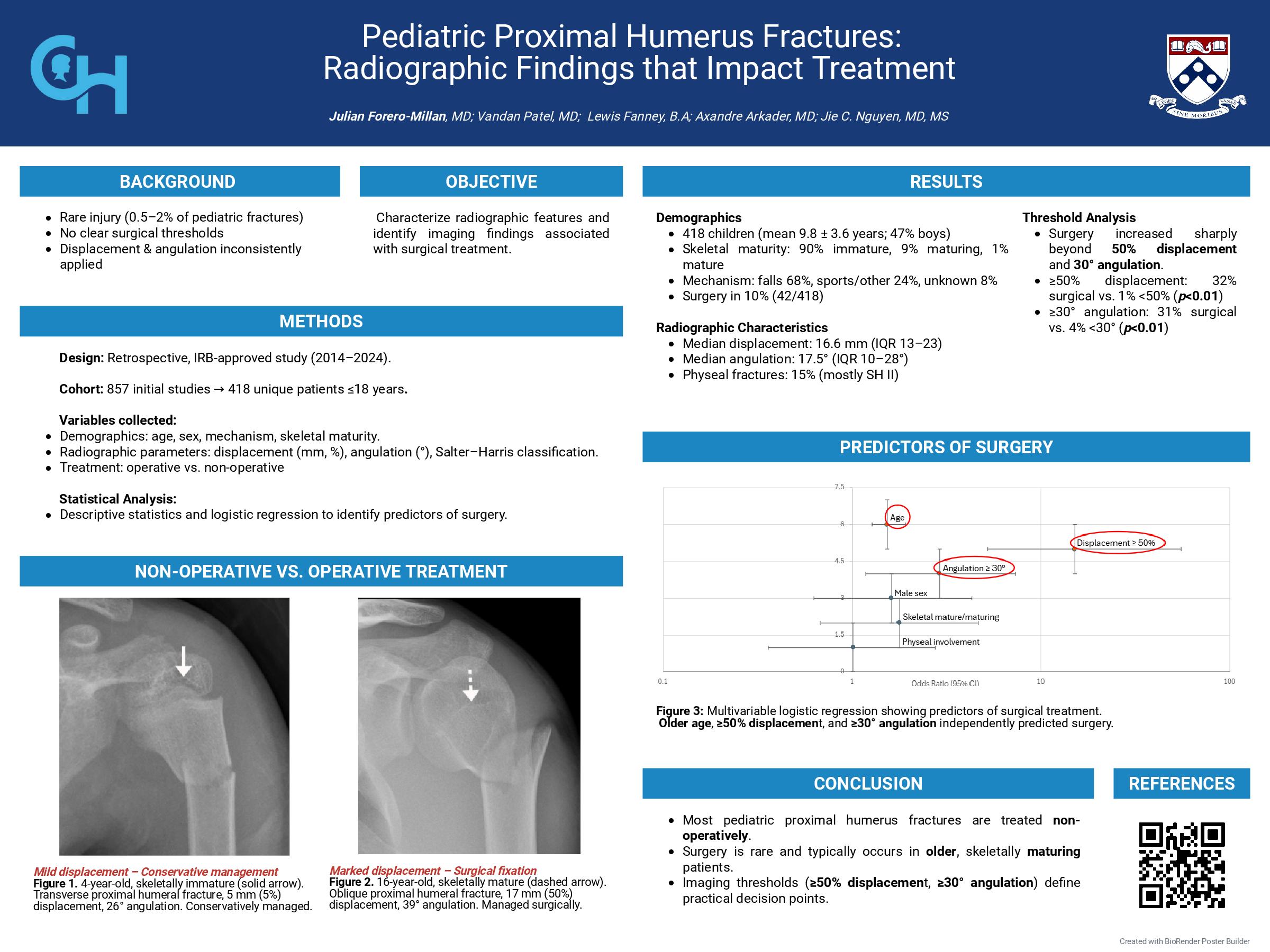
Purpose or Case Report: Pediatric proximal humerus fractures lack comprehensive radiographic characterization, limiting understanding of injury patterns and surgical criteria. This study aimed to characterize radiographic patterns of proximal humerus fractures across skeletal maturity and identify predictors of surgery.
Methods & Materials: This IRB-approved retrospective case series included pediatric patients (≤18 years) with radiographically confirmed proximal humerus fractures over a 10-year period. Cases were identified by radiology report search using the terms “proximal humerus fracture,” “radiographs,” and “humerus.” Duplicates, patients >18 years, non-proximal fractures, and unconfirmed cases were excluded. Skeletal maturity, Salter-Harris pattern, maximum fracture displacement, angulation, and physeal involvement were collected along with demographics, injury mechanism, and treatment. Patients were categorized according to treatment as surgical or non-surgical (conservative management). Logistic regression was used to identify radiographic and clinical factors associated with surgical treatment; p<0.05 was considered statistically significant.
Results: In 418 included children (mean age 10.5±7.2 years, range, 1–17; 47% boys); 376 fractures occurred in skeletally immature, 37 in maturing, and 5 in mature shoulders. Physeal involvement occurred in 58 (15.4%) immature shoulders, predominantly Salter–Harris II (n=50, 86%). Median overall fracture displacement was 4.1mm (IQR, 2.0-11.2); relative displacement (percentage of shaft width) was 24% (IQR, 12-53%), and angulation was 17.5° (IQR, 10–28°). Among 380 patients with available follow-up radiographs, the median follow-up duration was 1.7 months (IQR, 1.0–2.5). Overall, 42 (10%) underwent surgery. Stepwise analysis found a significant association between surgery and ≥50 % displacement (33 % vs 1 %, p<0.01) and ≥30° angulation (33% vs 4%, p<0.01). On multivariable analysis, independent predictors of surgery included older age (OR, 1.53, 95% CI 1.28–1.92, p<0.01), ≥50% fracture displacement (OR 15.1, 95% CI 5.22–55.21, p<0.01), and angulation ≥30° (OR 2.91, 95% CI 1.18–7.36, p<0.02).
Conclusions: Fracture displacement ≥50% and angulation ≥30° were the strongest radiographic predictors of surgery in pediatric proximal humerus fractures, with older age also independently associated with operative management. Reporting these imaging findings can help guide clinical decision-making and surgical referral.
Methods & Materials: This IRB-approved retrospective case series included pediatric patients (≤18 years) with radiographically confirmed proximal humerus fractures over a 10-year period. Cases were identified by radiology report search using the terms “proximal humerus fracture,” “radiographs,” and “humerus.” Duplicates, patients >18 years, non-proximal fractures, and unconfirmed cases were excluded. Skeletal maturity, Salter-Harris pattern, maximum fracture displacement, angulation, and physeal involvement were collected along with demographics, injury mechanism, and treatment. Patients were categorized according to treatment as surgical or non-surgical (conservative management). Logistic regression was used to identify radiographic and clinical factors associated with surgical treatment; p<0.05 was considered statistically significant.
Results: In 418 included children (mean age 10.5±7.2 years, range, 1–17; 47% boys); 376 fractures occurred in skeletally immature, 37 in maturing, and 5 in mature shoulders. Physeal involvement occurred in 58 (15.4%) immature shoulders, predominantly Salter–Harris II (n=50, 86%). Median overall fracture displacement was 4.1mm (IQR, 2.0-11.2); relative displacement (percentage of shaft width) was 24% (IQR, 12-53%), and angulation was 17.5° (IQR, 10–28°). Among 380 patients with available follow-up radiographs, the median follow-up duration was 1.7 months (IQR, 1.0–2.5). Overall, 42 (10%) underwent surgery. Stepwise analysis found a significant association between surgery and ≥50 % displacement (33 % vs 1 %, p<0.01) and ≥30° angulation (33% vs 4%, p<0.01). On multivariable analysis, independent predictors of surgery included older age (OR, 1.53, 95% CI 1.28–1.92, p<0.01), ≥50% fracture displacement (OR 15.1, 95% CI 5.22–55.21, p<0.01), and angulation ≥30° (OR 2.91, 95% CI 1.18–7.36, p<0.02).
Conclusions: Fracture displacement ≥50% and angulation ≥30° were the strongest radiographic predictors of surgery in pediatric proximal humerus fractures, with older age also independently associated with operative management. Reporting these imaging findings can help guide clinical decision-making and surgical referral.
More abstracts on this topic:
Cardiac Devices: Then and Now
Dennison Chelsea, Taylor Susan, Wilson Hunter, Slesnick Timothy, Riedesel Erica
Everything the Radiologist Needs to know about Scoliosis Surgery.Alsharief Alaa, El-hawary R., Schmit P.
Poster____SCI-057.pdf
Comments
We encourage you to join the discussion by posting your comments and questions below.
Presenters will be notified of your post so that they can respond as appropriate.
This discussion platform is provided to foster engagement, and stimulate conversation and knowledge sharing.
Please click here to review the full terms and conditions for engaging in the discussion, including refraining from product promotion and non-constructive feedback.
You have to be authorized to post a comment. Please,
Login or
Signup.
Please note that this is a separate login, not connected with your credentials used for the SPR main website.
Rate this abstract
(Maximum characters: 500)
Please note that this is a separate login, not connected with your credentials used for the SPR main website.