Not Available


Society for Pediatric Radiology – Poster Archive
Final ID: Poster #: SCI-047
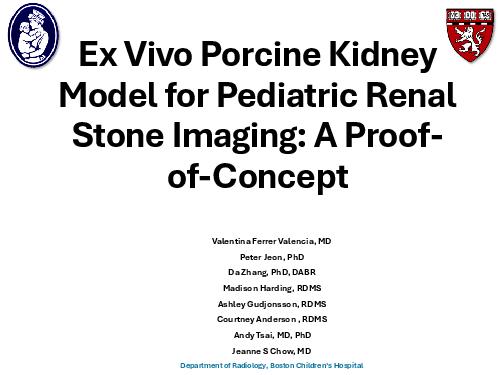
Ex Vivo Porcine Kidney Model for Pediatric Renal Stone Imaging: A Proof-of-Concept
Purpose or Case Report: Pediatric nephrolithiasis is on the rise, and as radiologists, we are faced with increasing demand for optimized diagnostic imaging, particularly in ultrasound and CT. We responded to this challenge by developing an ex vivo porcine model designed to simulate pediatric renal stones. This model serves as a testbed for stone detection and characterization via imaging, thereby providing clinicians with the diagnostic information they need to guide treatment.
Methods & Materials: Grocery-grade porcine kidneys were used to approximate pediatric renal parenchyma. Spherical stone surrogates were molded from B-complex vitamin pills (Nature Made, West Hills, CA) with diameters of 1, 2, 3, 4, 5, 6, and 10 mm. To prevent early dissolution, these stone surrogates were coated with acrylic varnish ≥24 hours before embedding them into the porcine renal parenchyma. Ultrasound and CT imaging of our porcine renal stone model were performed in the same session. For ultrasound, kidneys were submerged in a water bath to optimize acoustic coupling and reduce near-field artifacts. Qualitative imaging features (including echogenicity, posterior acoustic shadowing on ultrasound; and visibility on CT) were documented. To assess the stability of the stone surrogates, they were extracted and inspected at ~24 and ~48 hours.
Results: Porcine renal parenchyma showed sonographic echogenicity subjectively similar to pediatric kidneys. Surrogate stones demonstrated expected ultrasound features: discrete echogenic foci with posterior acoustic shadowing. The CT appearance of the porcine parenchyma and surrogate stones were similar to pediatric kidneys and real stones. Specifically, mean CT attenuation (±SD) was 55±5 HU for porcine parenchyma, and 513±39 HU for surrogate stones, similar to that of a comparison pediatric cohort (n=17; ages=4–16 years): 39±29 HU and 552±294 HU, respectively. Stone locations and sizes were qualitatively concordant between ultrasound and CT. All stone surrogates remained intact through 48 hours, except for the 10-mm surrogate, which showed partial surface dissolution.
Conclusions: We introduced a simple, low-cost, and ethically accessible solution—an ex vivo porcine model—to simulate pediatric renal stones. This innovative approach enables simultaneous ultrasound and CT assessment, completely bypassing patient radiation exposure, complex animal maintenance, and substantial costs. It thus serves as an ideal platform to optimize technical imaging parameters for stone detection across both ultrasound and CT.
Methods & Materials: Grocery-grade porcine kidneys were used to approximate pediatric renal parenchyma. Spherical stone surrogates were molded from B-complex vitamin pills (Nature Made, West Hills, CA) with diameters of 1, 2, 3, 4, 5, 6, and 10 mm. To prevent early dissolution, these stone surrogates were coated with acrylic varnish ≥24 hours before embedding them into the porcine renal parenchyma. Ultrasound and CT imaging of our porcine renal stone model were performed in the same session. For ultrasound, kidneys were submerged in a water bath to optimize acoustic coupling and reduce near-field artifacts. Qualitative imaging features (including echogenicity, posterior acoustic shadowing on ultrasound; and visibility on CT) were documented. To assess the stability of the stone surrogates, they were extracted and inspected at ~24 and ~48 hours.
Results: Porcine renal parenchyma showed sonographic echogenicity subjectively similar to pediatric kidneys. Surrogate stones demonstrated expected ultrasound features: discrete echogenic foci with posterior acoustic shadowing. The CT appearance of the porcine parenchyma and surrogate stones were similar to pediatric kidneys and real stones. Specifically, mean CT attenuation (±SD) was 55±5 HU for porcine parenchyma, and 513±39 HU for surrogate stones, similar to that of a comparison pediatric cohort (n=17; ages=4–16 years): 39±29 HU and 552±294 HU, respectively. Stone locations and sizes were qualitatively concordant between ultrasound and CT. All stone surrogates remained intact through 48 hours, except for the 10-mm surrogate, which showed partial surface dissolution.
Conclusions: We introduced a simple, low-cost, and ethically accessible solution—an ex vivo porcine model—to simulate pediatric renal stones. This innovative approach enables simultaneous ultrasound and CT assessment, completely bypassing patient radiation exposure, complex animal maintenance, and substantial costs. It thus serves as an ideal platform to optimize technical imaging parameters for stone detection across both ultrasound and CT.
More abstracts on this topic:
A Rare Case of a Twin Molar Pregnancy Featuring a Complete Hydatidiform Mole and a Coexisting Live Fetus
Elcic Lana, Nashawaty Motassem, Mousa Abeer, Wermers Joshua
Academic Clinical Practice Audit of Imaging for Pediatric Patients Presenting with Breast SymptomsJohnson Abigail, Chapman Teresa, Elezaby Mai, Fowler Amy
Poster____SCI-047.pdf
Comments
We encourage you to join the discussion by posting your comments and questions below.
Presenters will be notified of your post so that they can respond as appropriate.
This discussion platform is provided to foster engagement, and stimulate conversation and knowledge sharing.
Please click here to review the full terms and conditions for engaging in the discussion, including refraining from product promotion and non-constructive feedback.
You have to be authorized to post a comment. Please,
Login or
Signup.
Please note that this is a separate login, not connected with your credentials used for the SPR main website.
Rate this abstract
(Maximum characters: 500)
Please note that this is a separate login, not connected with your credentials used for the SPR main website.