Not Available


Society for Pediatric Radiology – Poster Archive
Final ID: Poster #: SCI-010
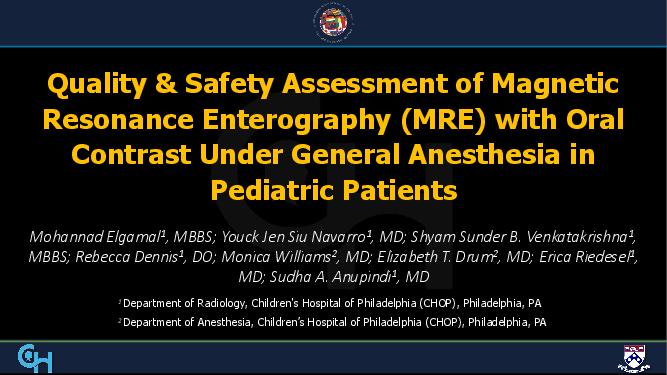
Quality and Safety of Conducting Magnetic Resonance Enterography with Oral Contrast Under General Anesthesia in Pediatric Patients
Purpose or Case Report: Magnetic resonance enterography (MRE) with oral contrast has become a necessary imaging modality for diagnosing various abnormalities. A challenge faced in younger patients is cooperation and oral contrast tolerance. General anesthesia (GA) becomes essential for optimal imaging, ensuring patient safety and comfort. This study describes our experience with conducting MREs under GA in high-risk pediatric patients and aims to demonstrate the safety and success of this practice.
Methods & Materials: Retrospective data from 71 MRE scans performed under GA via endotracheal intubation were collected. Pediatric anesthesiologists provided supporting variables such as length of anesthesia & American Society of Anesthesiologists (ASA) risk assessment scores. Oral contrast was dosed at 10-20 ml/kg for patients ≤ 5 years old & administered 1 hour prior to scan via nasogastric tube. MRE scans were blindly reviewed by 3 pediatric radiologists, assessing the quality of the images and progression of oral contrast. Descriptive statistics were analyzed.
Results: The median age was 7.6 years (0.8-20.9). 44 patients were male. The major indication for MRE was IBD work-up (33) followed by evaluation of small bowel obstruction (12). The leading indications for undergoing GA was “age under 6 years” (26), autism spectrum disorder (13), and patients with neurodevelopmental delay (9). Post-anesthesia incidents occurred in 2 patients, one of which had a sore throat after extubation, and another had respiratory decompensation secondary to prior pneumonia. No patient had documented aspiration events. 63% of patients had an ASA score ≥3. The median GA run time was 169 minutes (118-311), while the median scan time was 55 (25-131). Readers rated the quality of the study as either non-diagnostic, inadequate, adequate, or very good. On average, the readers rated 51% of scans as adequate and 21% as very good. No scans were found to be inadequate and/or non-diagnostic . Readers also found 38% of scans to demonstrate good progression, adequate opacification, and no motion artifacts. All readers agree that the primary limitation to the quality was the poor progression of contrast to the small bowel (23%).
Conclusions: This study highlights our positive experience performing MREs with oral contrast under GA in high-risk pediatric patients. The procedures were conducted safely, with no instances of aspiration or serious immediate adverse events and adequate diagnostic images were obtained.
Methods & Materials: Retrospective data from 71 MRE scans performed under GA via endotracheal intubation were collected. Pediatric anesthesiologists provided supporting variables such as length of anesthesia & American Society of Anesthesiologists (ASA) risk assessment scores. Oral contrast was dosed at 10-20 ml/kg for patients ≤ 5 years old & administered 1 hour prior to scan via nasogastric tube. MRE scans were blindly reviewed by 3 pediatric radiologists, assessing the quality of the images and progression of oral contrast. Descriptive statistics were analyzed.
Results: The median age was 7.6 years (0.8-20.9). 44 patients were male. The major indication for MRE was IBD work-up (33) followed by evaluation of small bowel obstruction (12). The leading indications for undergoing GA was “age under 6 years” (26), autism spectrum disorder (13), and patients with neurodevelopmental delay (9). Post-anesthesia incidents occurred in 2 patients, one of which had a sore throat after extubation, and another had respiratory decompensation secondary to prior pneumonia. No patient had documented aspiration events. 63% of patients had an ASA score ≥3. The median GA run time was 169 minutes (118-311), while the median scan time was 55 (25-131). Readers rated the quality of the study as either non-diagnostic, inadequate, adequate, or very good. On average, the readers rated 51% of scans as adequate and 21% as very good. No scans were found to be inadequate and/or non-diagnostic . Readers also found 38% of scans to demonstrate good progression, adequate opacification, and no motion artifacts. All readers agree that the primary limitation to the quality was the poor progression of contrast to the small bowel (23%).
Conclusions: This study highlights our positive experience performing MREs with oral contrast under GA in high-risk pediatric patients. The procedures were conducted safely, with no instances of aspiration or serious immediate adverse events and adequate diagnostic images were obtained.
More abstracts on this topic:
Quality Assessment of Ultrashort Echo Time (UTE) Proton Lung MRI in Pediatric Patients
Tan Fei, Zapala Matthew, Durand Rachelle, Chan Marilynn, Larson Peder
Fetal cardiac magnetic resonance imaging (FCMR) using a prospective ECG-pseudogating method: frequency of visualization of standard cardiac planes and image quality between 1.5 and 3 Tesla (T).Goncalves Luis, Lindblade Christopher, Cornejo Patricia, Patel Mittun, Wishah Fidaa, Bardo Dianna
Poster____SCI-010.pdf
Comments
We encourage you to join the discussion by posting your comments and questions below.
Presenters will be notified of your post so that they can respond as appropriate.
This discussion platform is provided to foster engagement, and stimulate conversation and knowledge sharing.
Please click here to review the full terms and conditions for engaging in the discussion, including refraining from product promotion and non-constructive feedback.
You have to be authorized to post a comment. Please,
Login or
Signup.
Please note that this is a separate login, not connected with your credentials used for the SPR main website.
Rate this abstract
(Maximum characters: 500)
Please note that this is a separate login, not connected with your credentials used for the SPR main website.