Not Available


Society for Pediatric Radiology – Poster Archive
Final ID: Poster #: SCI-046
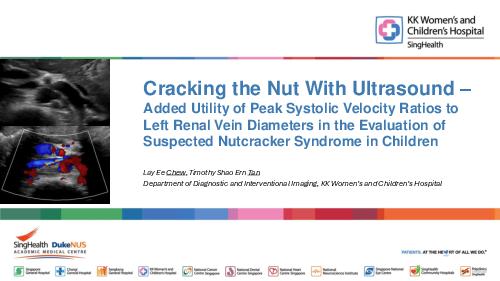
Cracking the Nut With Ultrasound – Added Utility of Peak Systolic Velocity Ratios to Left Renal Vein Diameters in the Evaluation of Suspected Nutcracker Syndrome in Children
Purpose or Case Report: Nutcracker syndrome (NCS) results from left renal vein (LRV) compression, typically between the abdominal aorta and superior mesenteric artery. The use of ultrasonography (US) to aid in diagnosis can be challenging due to the dynamic nature of the nutcracker phenomenon (NCP) and variability of symptoms, which can fluctuate with changes in patient posture and respiration. Moreover, defining a reliable Doppler threshold in children remains underexplored. This study explores the added utility of Doppler peak systolic velocity (PSV) ratio to LRV diameters in the evaluation of suspected NCS.
Methods & Materials: All US studies performed for suspected NCS between Nov 2024- Sep 2025 were retrospectively reviewed. LRV diameters and PSV was measured at the renal hilum (H) and aortomesenteric level (AM), with the diameter (H/AM) and PSV ratios (AM/H) calculated. Both ratios were dichotomized at pre-specified thresholds of ≥5:1 to define a “positive” test for NCP, with clinical diagnosis also serving as reference standard. Diagnostic performance was evaluated using standard matrices, including area under the receiver-operating-characteristics curve (AUROC). Secondary outcomes included agreement between both ratios.
Results: Of 41 children (mean age 11.8 years, range 1.4-18.9 years), 22 (53.6%) were clinically diagnosed with NCS whilst 10 (24.4%) were indeterminate for NCS. The mean diameter and PSV ratios for children were 4.93 (range 1.31-11.0) and 3.65 (range 0.78-15.3) respectively (p=0.002). The AUROC of diameter and PSV ratios were 0.613 (95% CI 0.39–0.84) and 0.652 (95% CI 0.46–0.85) respectively, with no significant difference (p=0.80). PSV≥5:1 yielded 68.3% diagnostic accuracy, 40.9% sensitivity and 100% specificity, while LRV diameter≥5:1 achieved 63.4% diagnostic accuracy, 63.6% sensitivity and 63.2% specificity. When combined, both ratios achieved 74.1% diagnostic accuracy, 53.3% sensitivity and 100% specificity. Both ratios showed high positive correlation (Spearman’s r=0.54, p<0.001).
Conclusions: While the individual performance of LRV diameter and PSV ratios was modest, incorporating both parameters improved overall diagnostic accuracy and specificity, underscoring their complementary value. The addition of PSV ratio to standard diameter assessment enhances confidence in non-invasive diagnosis and may reduce reliance on CT or MR venography. Larger, prospective studies are warranted to refine pediatric-specific Doppler thresholds and validate combined criteria for clinical use.
Methods & Materials: All US studies performed for suspected NCS between Nov 2024- Sep 2025 were retrospectively reviewed. LRV diameters and PSV was measured at the renal hilum (H) and aortomesenteric level (AM), with the diameter (H/AM) and PSV ratios (AM/H) calculated. Both ratios were dichotomized at pre-specified thresholds of ≥5:1 to define a “positive” test for NCP, with clinical diagnosis also serving as reference standard. Diagnostic performance was evaluated using standard matrices, including area under the receiver-operating-characteristics curve (AUROC). Secondary outcomes included agreement between both ratios.
Results: Of 41 children (mean age 11.8 years, range 1.4-18.9 years), 22 (53.6%) were clinically diagnosed with NCS whilst 10 (24.4%) were indeterminate for NCS. The mean diameter and PSV ratios for children were 4.93 (range 1.31-11.0) and 3.65 (range 0.78-15.3) respectively (p=0.002). The AUROC of diameter and PSV ratios were 0.613 (95% CI 0.39–0.84) and 0.652 (95% CI 0.46–0.85) respectively, with no significant difference (p=0.80). PSV≥5:1 yielded 68.3% diagnostic accuracy, 40.9% sensitivity and 100% specificity, while LRV diameter≥5:1 achieved 63.4% diagnostic accuracy, 63.6% sensitivity and 63.2% specificity. When combined, both ratios achieved 74.1% diagnostic accuracy, 53.3% sensitivity and 100% specificity. Both ratios showed high positive correlation (Spearman’s r=0.54, p<0.001).
Conclusions: While the individual performance of LRV diameter and PSV ratios was modest, incorporating both parameters improved overall diagnostic accuracy and specificity, underscoring their complementary value. The addition of PSV ratio to standard diameter assessment enhances confidence in non-invasive diagnosis and may reduce reliance on CT or MR venography. Larger, prospective studies are warranted to refine pediatric-specific Doppler thresholds and validate combined criteria for clinical use.
More abstracts on this topic:
Wilms' tumor arising in Horseshoe Kidney. Report of two cases.
Sala Simone, Cirillo Marco, Raimondi Edoardo, Bassi Matteo
Traumatic solid abdominal organ injury in the paediatric population – what you need to know and what you need to look out forAdu John, Mcdonald Kirsteen
Poster____SCI-046.pdf
Comments
We encourage you to join the discussion by posting your comments and questions below.
Presenters will be notified of your post so that they can respond as appropriate.
This discussion platform is provided to foster engagement, and stimulate conversation and knowledge sharing.
Please click here to review the full terms and conditions for engaging in the discussion, including refraining from product promotion and non-constructive feedback.
You have to be authorized to post a comment. Please,
Login or
Signup.
Please note that this is a separate login, not connected with your credentials used for the SPR main website.
Rate this abstract
(Maximum characters: 500)
Please note that this is a separate login, not connected with your credentials used for the SPR main website.