Not Available


Society for Pediatric Radiology – Poster Archive
Final ID: Poster #: SCI-026
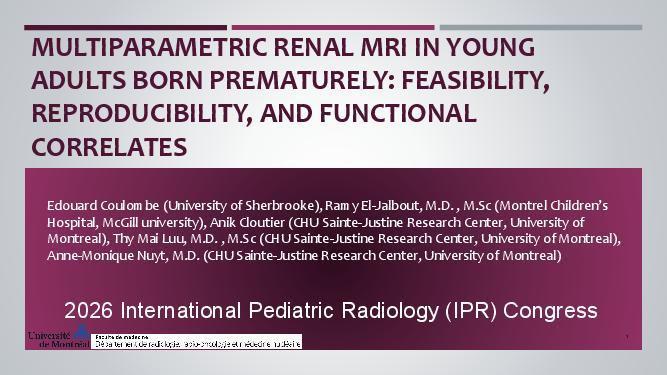
Multiparametric Renal MRI in Young Adults Born Prematurely: Feasibility, Reproducibility, and Functional Correlates
Purpose or Case Report: Chronic kidney disease (CKD) has a prevalence of 18% among adults born preterm. The standard diagnostic method is renal biopsy combined with Glomerular Filtration Rate (GFR) estimation. However, these methods are limited by their invasiveness and lack of sensitivity in the early stages. The lack of guidelines for assessing kidney function in young adults born prematurely highlights the need to develop screening methods for early CKD detection. The objectives are to evaluate feasibility and reproducibility of multiparametric MRI (MpMRI) sequences and explore associations with anthropometric and renal function.
Methods & Materials: This is a prospective observational study in which young adults aged 18 to 40 years born prematurely (≤30 weeks GA) and controls born at term (≥37 weeks GA) were recruited in the Health of Adults born Preterm Investigation cohort from July 2021 to February 2024. Anthropometrics, demographics, laboratory data and MRI using a 1.5T machine (Philips Ingenia) and MATLAB R2021a were obtained. MpMRI included T1 mapping (structure), PCASL (perfusion), T2*BOLD (oxygenation), and IVIM (structure). Descriptive, reproducibility, and correlation analyses were performed using SPSS.
Results: 156 participants were included, mean age 30 years (interval 18 to 39), 61 (40.7%) were men. Feasibility was 96.7%. ICC ranged between 0.72 and 0.99, indicating excellent reproducibility. Corticomedullary differentiation was significant for T1 (p < 0.001), PCASL (p < 0.001), ADC (p = 0.024) and IVIM (p < 0.001). For the premature group, medullary T1 map correlated significantly with BMI (p = 0.043). T2*BOLD cortical signal correlated with BMI (p = 0.014) and systolic blood pressure (p = 0.045). T2*BOLD medullary signal inversely correlated with age (p = 0.032). PCASL signal in renal cortex correlated with systolic blood pressure (p = 0.047). Significant inverse correlations were found between mean cortex ADC values and BMI (p = 0.019) and gestational age (GA) (p = 0.011).
Conclusions: 1.5T MpMRI is a feasible, reproducible, and non-invasive approach for evaluating early renal structural and perfusion changes associated with CKD in young adults born preterm. Our findings suggest that T1, PCASL, ADC, and IVIM allow for precise corticomedullary differentiation. We identified significant correlations between T1, PCASL, T2*BOLD, ADC, and key anthropometric characteristics among the preterm group, underscoring the relevance of MpMRI for detecting early structural and perfusion changes related to early CKD.
Methods & Materials: This is a prospective observational study in which young adults aged 18 to 40 years born prematurely (≤30 weeks GA) and controls born at term (≥37 weeks GA) were recruited in the Health of Adults born Preterm Investigation cohort from July 2021 to February 2024. Anthropometrics, demographics, laboratory data and MRI using a 1.5T machine (Philips Ingenia) and MATLAB R2021a were obtained. MpMRI included T1 mapping (structure), PCASL (perfusion), T2*BOLD (oxygenation), and IVIM (structure). Descriptive, reproducibility, and correlation analyses were performed using SPSS.
Results: 156 participants were included, mean age 30 years (interval 18 to 39), 61 (40.7%) were men. Feasibility was 96.7%. ICC ranged between 0.72 and 0.99, indicating excellent reproducibility. Corticomedullary differentiation was significant for T1 (p < 0.001), PCASL (p < 0.001), ADC (p = 0.024) and IVIM (p < 0.001). For the premature group, medullary T1 map correlated significantly with BMI (p = 0.043). T2*BOLD cortical signal correlated with BMI (p = 0.014) and systolic blood pressure (p = 0.045). T2*BOLD medullary signal inversely correlated with age (p = 0.032). PCASL signal in renal cortex correlated with systolic blood pressure (p = 0.047). Significant inverse correlations were found between mean cortex ADC values and BMI (p = 0.019) and gestational age (GA) (p = 0.011).
Conclusions: 1.5T MpMRI is a feasible, reproducible, and non-invasive approach for evaluating early renal structural and perfusion changes associated with CKD in young adults born preterm. Our findings suggest that T1, PCASL, ADC, and IVIM allow for precise corticomedullary differentiation. We identified significant correlations between T1, PCASL, T2*BOLD, ADC, and key anthropometric characteristics among the preterm group, underscoring the relevance of MpMRI for detecting early structural and perfusion changes related to early CKD.
More abstracts on this topic:
Cracking the Nut With Ultrasound – Added Utility of Peak Systolic Velocity Ratios to Left Renal Vein Diameters in the Evaluation of Suspected Nutcracker Syndrome in Children
Chew Lay Ee, Tan Timothy Shao Ern
Renal Agenesis Presenting with Acute Kidney Injury in a 6-Month Old with Smith-Lemli-Opitz Syndrome: A Case ReportEl-hayani Reem, Malik Ammara, Manickam Sivakumar
Poster____SCI-026.pdf
Comments
We encourage you to join the discussion by posting your comments and questions below.
Presenters will be notified of your post so that they can respond as appropriate.
This discussion platform is provided to foster engagement, and stimulate conversation and knowledge sharing.
Please click here to review the full terms and conditions for engaging in the discussion, including refraining from product promotion and non-constructive feedback.
You have to be authorized to post a comment. Please,
Login or
Signup.
Please note that this is a separate login, not connected with your credentials used for the SPR main website.
Rate this abstract
(Maximum characters: 500)
Please note that this is a separate login, not connected with your credentials used for the SPR main website.