Not Available


Society for Pediatric Radiology – Poster Archive
Final ID: Poster #: EDU-004
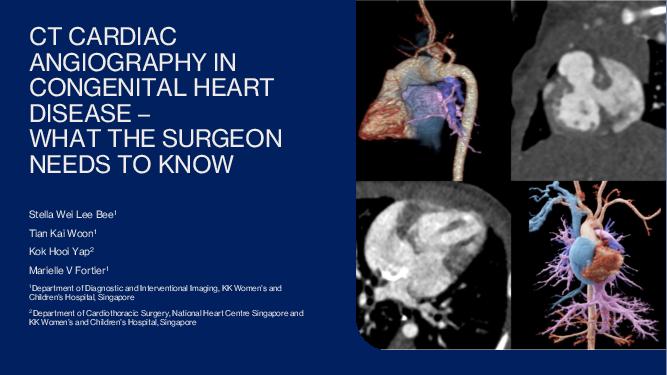
CT Cardiac Angiogram for Congenital Heart Disease – What the Surgeon Wants to Know
Purpose or Case Report: In congenital heart disease (CHD), CT cardiac angiography (CTCA) has an important role in surgical planning and evaluating post-surgical complications, complementing echocardiography and cardiac magnetic resonance imaging (cMRI). Its strengths are in its high spatial resolution, rapid acquisition, and excellent 3D reconstruction capabilities for visualization of complex vascular and intracardiac relationships. However, unless radiologists tailor reconstructions and reports to address the surgeons’ needs, its full potential is underutilized. To do this, radiologists need to be aware of at least broad strokes of cardiac pathophysiology, as well as modern surgical approaches and potential post-surgical complications, for the most common CHDs. This will ensure that the utility of CTCA reports transcend volumetric and vascular measurements, and instead, anticipate technical challenges, identify hidden hazards, shape surgical strategy and pick up specific post-surgical complications.
We propose structured CTCA reporting framework for CHD centred on the needs of the surgeon, by prioritising specific information surgeons find most useful across various CHD conditions. The objectives of this poster are a) to review, by consensus with paediatric cardiac surgeons, the key imaging features in CTCA based on different CHD lesions. b) To propose a reporting checklist for CTCA that emphasizes those key features. c) To demonstrate application of this surgeon centric framework via illustrative cases, focusing on the tetralogy of Fallot, transposition of great arteries, total or partial anomalous pulmonary venous return, and coarctation of the aorta.
Methods & Materials:
Results:
Conclusions: By aligning CTCA reporting with what surgeons need — in terms of spatial relationships, obstruction detail, coronary anatomy, and surgical windows — a CTCA report can be transformed from passive documentation into active preoperative guidance, as well as post surgical follow up. We believe this can improve planning, reduce surprises, and ultimately enhance outcomes in CHD surgery.
We propose structured CTCA reporting framework for CHD centred on the needs of the surgeon, by prioritising specific information surgeons find most useful across various CHD conditions. The objectives of this poster are a) to review, by consensus with paediatric cardiac surgeons, the key imaging features in CTCA based on different CHD lesions. b) To propose a reporting checklist for CTCA that emphasizes those key features. c) To demonstrate application of this surgeon centric framework via illustrative cases, focusing on the tetralogy of Fallot, transposition of great arteries, total or partial anomalous pulmonary venous return, and coarctation of the aorta.
Methods & Materials:
Results:
Conclusions: By aligning CTCA reporting with what surgeons need — in terms of spatial relationships, obstruction detail, coronary anatomy, and surgical windows — a CTCA report can be transformed from passive documentation into active preoperative guidance, as well as post surgical follow up. We believe this can improve planning, reduce surprises, and ultimately enhance outcomes in CHD surgery.
More abstracts on this topic:
State of the Art CT Imaging of Congenital Heart Disease: Pre and Post-Operative Appearance
Steinberg Julie, Siegel Marilyn
Complications Associated with Single Ventricle Heart Defects in a NewbornOrdonez Alvaro, Stecher Priscilla, Rogers Lindsay, Bhatti Tricia, Noor Abass
Poster____EDU-004.pdf
Comments
We encourage you to join the discussion by posting your comments and questions below.
Presenters will be notified of your post so that they can respond as appropriate.
This discussion platform is provided to foster engagement, and stimulate conversation and knowledge sharing.
Please click here to review the full terms and conditions for engaging in the discussion, including refraining from product promotion and non-constructive feedback.
You have to be authorized to post a comment. Please,
Login or
Signup.
Please note that this is a separate login, not connected with your credentials used for the SPR main website.
Rate this abstract
(Maximum characters: 500)
Please note that this is a separate login, not connected with your credentials used for the SPR main website.