Not Available


Society for Pediatric Radiology – Poster Archive
Final ID: Poster #: SCI-042
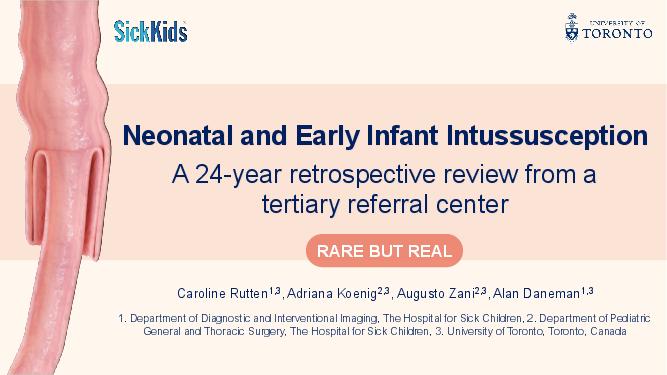
Neonatal and Early Infant Intussusception: A 24-Year Retrospective Review from a Tertiary Referral Center
Purpose or Case Report: Intussusception in neonates and young infants is rare, with limited data to guide management. This study aims to characterize the presentation, management and outcomes of intussusception in infants ≤100 days of age.
Methods & Materials: Radiology reports were searched for the keyword “intussusception” in infants ≤100 days over a 24-year period (January 1, 2000-July 31, 2024). Patient charts were reviewed, and cases with negative imaging studies were excluded. Data were analyzed for patient demographics, presenting symptoms, imaging and management approach, including operative or non-operative interventions, with intussusceptions classified as small bowel–small bowel (SB/SB), enteric tube–related SB/SB, or ileocolic.
Results: Of 301 charts reviewed, 124 neonates and young infants ≤100 days of age met inclusion criteria (median age, 55 days; range, 0–100 days). SB/SB intussusception accounted for 93/124 cases (75%), including 36 (39%) enteric tube-related. Most SB/SB cases were incidental findings, and only one required surgery. Thirty-one infants (25%) had ileocolic intussusception. Air enema was attempted in 26, with a success rate of 80% (21/26) and no perforations occurred. Surgical intervention was required in 9 cases, revealing pathologic lead points in 4 cases (duplication cysts, n=2; Meckel’s diverticulum, n=1; inspissated meconium, n=1). Management of enteric tube–related intussusceptions consisted primarily of conservative measures such as tube withdrawal or removal, with complete resolution and no cases requiring surgery.
Conclusions: Pediatric tertiary referral centers can expect to manage approximately five cases of intussusception in infants aged <100 days annually. SB/SB intussusceptions predominate and rarely require intervention. Ileocolic intussusception accounts for 25% of cases, with air enema proving safe and effective in most cases. Pathologic lead points appear more frequent in this age group than in older children.
Methods & Materials: Radiology reports were searched for the keyword “intussusception” in infants ≤100 days over a 24-year period (January 1, 2000-July 31, 2024). Patient charts were reviewed, and cases with negative imaging studies were excluded. Data were analyzed for patient demographics, presenting symptoms, imaging and management approach, including operative or non-operative interventions, with intussusceptions classified as small bowel–small bowel (SB/SB), enteric tube–related SB/SB, or ileocolic.
Results: Of 301 charts reviewed, 124 neonates and young infants ≤100 days of age met inclusion criteria (median age, 55 days; range, 0–100 days). SB/SB intussusception accounted for 93/124 cases (75%), including 36 (39%) enteric tube-related. Most SB/SB cases were incidental findings, and only one required surgery. Thirty-one infants (25%) had ileocolic intussusception. Air enema was attempted in 26, with a success rate of 80% (21/26) and no perforations occurred. Surgical intervention was required in 9 cases, revealing pathologic lead points in 4 cases (duplication cysts, n=2; Meckel’s diverticulum, n=1; inspissated meconium, n=1). Management of enteric tube–related intussusceptions consisted primarily of conservative measures such as tube withdrawal or removal, with complete resolution and no cases requiring surgery.
Conclusions: Pediatric tertiary referral centers can expect to manage approximately five cases of intussusception in infants aged <100 days annually. SB/SB intussusceptions predominate and rarely require intervention. Ileocolic intussusception accounts for 25% of cases, with air enema proving safe and effective in most cases. Pathologic lead points appear more frequent in this age group than in older children.
More abstracts on this topic:
Neonatal Neurosonography Practices: A Survey of Active SPR Members
Leschied Jessica, Horst Kelly, Lampl Brooke, Hwang Misun
Atypical Idiopathic Ileocolic Intussusception – When to Treat Someone Like a KidBurns Madisen, Cao Joseph
Poster____SCI-042.pdf
Comments
We encourage you to join the discussion by posting your comments and questions below.
Presenters will be notified of your post so that they can respond as appropriate.
This discussion platform is provided to foster engagement, and stimulate conversation and knowledge sharing.
Please click here to review the full terms and conditions for engaging in the discussion, including refraining from product promotion and non-constructive feedback.
You have to be authorized to post a comment. Please,
Login or
Signup.
Please note that this is a separate login, not connected with your credentials used for the SPR main website.
Rate this abstract
(Maximum characters: 500)
Please note that this is a separate login, not connected with your credentials used for the SPR main website.