Not Available


Society for Pediatric Radiology – Poster Archive
Final ID: Poster #: SCI-025
Improved Diagnostic Confidence in Neonatal Lung Imaging Using Deep Learning–enhanced ZTE MRI in Bronchopulmonary Dysplasia
Purpose or Case Report: Qualitative scores of parenchymal disease severity from 3D lung MRI predict clinical outcomes such as duration of respiratory support in infants with BPD. However, current methods suffer from low signal-to-noise ratio (SNR) and motion-related blurring, reducing interpretability and diagnostic confidence. The inherently quiet zero echo time (ZTE) MRI with deep learning reconstruction (DLR) may improve diagnostic reliability but has not been evaluated in infants. This study assessed the feasibility of ZTE MRI and image quality improvements with DLR in infants with BPD.
Methods & Materials: ZTE MRI with and without DLR (resolution = 0.39-0.55 x 0.39-0.55 x 0.8-1.00 mm) was performed in 24 infants with BPD on a 1.5 T scanner (SIGNA Artist, GE HealthCare) at 41±7 weeks post-menstrual age. Six infants with severe BPD required invasive ventilation at the MRI, while 18 received non-invasive oxygen support. Three radiologists independently scored image quality (IQ) from 1 (non-diagnostic) to 5 (excellent). Quantitative IQ metrics were assessed using apparent SNR and image sharpness of the lung parenchyma. Readers assigned one modified Ochiai score per patient, incorporating hyperexpansion, mosaic attenuation, cysts (number and size), fibrous/interstitial opacities, distortion of bronchovascular bundles, and overall subjective impression (total score=0–14).
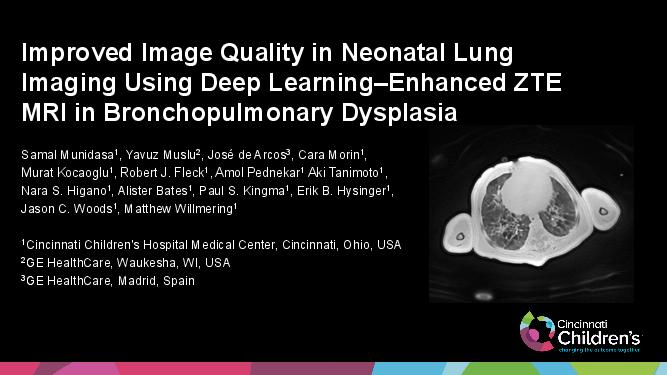
Results: IQ for the DLR images was considered above average while the non-DLR images were deemed poor-average quality (3.6±0.7 vs. 2.1±0.7, p<0.0001, respectively). 12.5% of the non-DLR images were considered non-diagnostic, whereas all DLR images were diagnostic. DLR images showed 52±32% higher parenchymal SNR than non-DLR images (p<0.0001) and significantly greater image sharpness (p=0.008) demonstrated by improved delineation of small structural abnormalities, such as cystic regions. Total Ochiai scores correlated with DLR IQ (Spearman r=0.49, p=0.017), but not SNR (r=-0.07, p=0.764). There were no significant differences in DLR IQ (p=0.347) or SNR (p=0.183) between ventilated and non-ventilated infants, suggesting IQ may not be influenced by disease severity but improved confidence and sensitivity in detecting structural abnormalities.
Conclusions: DLR-enhanced ZTE MRI significantly improved IQ, sharpness, and parenchymal SNR in infants with BPD, eliminating non-diagnostic scans and enhancing diagnostic confidence. These findings support the feasibility of ZTE MRI with DLR for high-fidelity, interpretable lung imaging in vulnerable neonatal populations.
Methods & Materials: ZTE MRI with and without DLR (resolution = 0.39-0.55 x 0.39-0.55 x 0.8-1.00 mm) was performed in 24 infants with BPD on a 1.5 T scanner (SIGNA Artist, GE HealthCare) at 41±7 weeks post-menstrual age. Six infants with severe BPD required invasive ventilation at the MRI, while 18 received non-invasive oxygen support. Three radiologists independently scored image quality (IQ) from 1 (non-diagnostic) to 5 (excellent). Quantitative IQ metrics were assessed using apparent SNR and image sharpness of the lung parenchyma. Readers assigned one modified Ochiai score per patient, incorporating hyperexpansion, mosaic attenuation, cysts (number and size), fibrous/interstitial opacities, distortion of bronchovascular bundles, and overall subjective impression (total score=0–14).
Results: IQ for the DLR images was considered above average while the non-DLR images were deemed poor-average quality (3.6±0.7 vs. 2.1±0.7, p<0.0001, respectively). 12.5% of the non-DLR images were considered non-diagnostic, whereas all DLR images were diagnostic. DLR images showed 52±32% higher parenchymal SNR than non-DLR images (p<0.0001) and significantly greater image sharpness (p=0.008) demonstrated by improved delineation of small structural abnormalities, such as cystic regions. Total Ochiai scores correlated with DLR IQ (Spearman r=0.49, p=0.017), but not SNR (r=-0.07, p=0.764). There were no significant differences in DLR IQ (p=0.347) or SNR (p=0.183) between ventilated and non-ventilated infants, suggesting IQ may not be influenced by disease severity but improved confidence and sensitivity in detecting structural abnormalities.
Conclusions: DLR-enhanced ZTE MRI significantly improved IQ, sharpness, and parenchymal SNR in infants with BPD, eliminating non-diagnostic scans and enhancing diagnostic confidence. These findings support the feasibility of ZTE MRI with DLR for high-fidelity, interpretable lung imaging in vulnerable neonatal populations.
More abstracts on this topic:
Fetal Liver T2* Values using 3.0 T MRI
Marin Concha Julio, Qu Feifei, Hernandez Andrade Edgar, Jella Pavan, Mody Swati, Subramanian Karthikeyan, Ghassaban Kiarash, Romero Roberto, Haacke E.
Imaging Evaluation of Congenital and Acquired Causes of Neonatal Short Bowel SyndromeLlorens-salvador Roberto, Veiga-canuto Diana
Poster____SCI-025.pdf
Comments
We encourage you to join the discussion by posting your comments and questions below.
Presenters will be notified of your post so that they can respond as appropriate.
This discussion platform is provided to foster engagement, and stimulate conversation and knowledge sharing.
Please click here to review the full terms and conditions for engaging in the discussion, including refraining from product promotion and non-constructive feedback.
You have to be authorized to post a comment. Please,
Login or
Signup.
Please note that this is a separate login, not connected with your credentials used for the SPR main website.
Rate this abstract
(Maximum characters: 500)
Please note that this is a separate login, not connected with your credentials used for the SPR main website.