Not Available


Society for Pediatric Radiology – Poster Archive
Final ID: Poster #: SCI-023
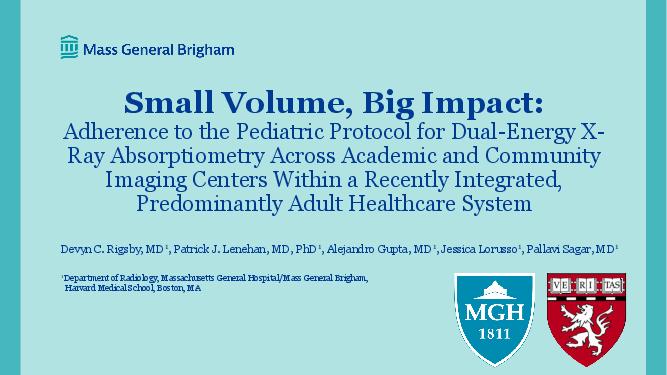
Small Volume, Big Impact: Adherence to the Pediatric Protocol for Dual-energy X-Ray Absorptiometry Across Academic and Community Imaging Centers within a Recently Integrated, Predominantly Adult Healthcare System
Purpose or Case Report: Health system integration presents challenges for radiology departments, especially in standardizing imaging protocols across new affiliate sites. In pediatric radiology, these challenges are amplified when adult-focused centers begin serving children, as pediatric imaging often requires protocol modifications. Per ACR-SPR-SSR guidelines, pediatric dual-energy x-ray absorptiometry (DXA) should include lumbar spine and total body images, which provide a more accurate measurement of bone mineral density in children than the standard adult DXA protocol. In our integrated health system, radiologists noted inconsistent use of the pediatric DXA protocol at new affiliate sites. This quality improvement (QI) study evaluated adherence to pediatric DXA protocols across imaging sites to inform targeted interventions to improve national guideline compliance.
Methods & Materials: All DXA studies in one health system performed on patients ≤ 18 years and interpreted by pediatric radiologists between January 1, 2020, and October 14, 2025, were identified using mPower (Nuance, Burlington, MA). Exam protocol, imaging site, and patient age and sex were collected for each study. Percentage of exams adhering to the pediatric protocol (total body and lumbar spine images) was determined for each site.
Results: In the study period, 207 pediatric patients underwent 253 DXA exams. Median patient age was 16 (IQR 4), and 118 patients (57%) were female. At the flagship hospital, 190 of 204 studies (93%) adhered to the pediatric protocol. The remaining exam protocols were: 11 (5%) lumbar spine and hip; 1 lumbar spine; 1 hip; and 1 hip and forearm. At the four newly integrated community imaging sites, 7 of 47 studies (15%) adhered to the pediatric protocol. The remaining exam protocols were: 38 (81%) lumbar spine and hip; 1 lumbar spine; and 1 lumbar spine, hip, and forearm.
Conclusions: Pediatric DXA was an infrequently performed exam with significant variation in protocol adherence across sites. While health system consolidation provides increased access to imaging for our pediatric patients, these results show the importance of QI to monitor compliance with national pediatric imaging guidelines at all affiliate sites. This study’s methodology can serve as a framework for further QI analyses in this and other health systems. Based on these results and interviews with stakeholders, our team will design, implement, and assess the impact of targeted interventions to improve pediatric DXA protocol adherence across the health system.
Methods & Materials: All DXA studies in one health system performed on patients ≤ 18 years and interpreted by pediatric radiologists between January 1, 2020, and October 14, 2025, were identified using mPower (Nuance, Burlington, MA). Exam protocol, imaging site, and patient age and sex were collected for each study. Percentage of exams adhering to the pediatric protocol (total body and lumbar spine images) was determined for each site.
Results: In the study period, 207 pediatric patients underwent 253 DXA exams. Median patient age was 16 (IQR 4), and 118 patients (57%) were female. At the flagship hospital, 190 of 204 studies (93%) adhered to the pediatric protocol. The remaining exam protocols were: 11 (5%) lumbar spine and hip; 1 lumbar spine; 1 hip; and 1 hip and forearm. At the four newly integrated community imaging sites, 7 of 47 studies (15%) adhered to the pediatric protocol. The remaining exam protocols were: 38 (81%) lumbar spine and hip; 1 lumbar spine; and 1 lumbar spine, hip, and forearm.
Conclusions: Pediatric DXA was an infrequently performed exam with significant variation in protocol adherence across sites. While health system consolidation provides increased access to imaging for our pediatric patients, these results show the importance of QI to monitor compliance with national pediatric imaging guidelines at all affiliate sites. This study’s methodology can serve as a framework for further QI analyses in this and other health systems. Based on these results and interviews with stakeholders, our team will design, implement, and assess the impact of targeted interventions to improve pediatric DXA protocol adherence across the health system.
More abstracts on this topic:
Low Dose Imaging for Feeding Tube Confirmation
Flowers Colleen, Kaplan Summer, Zhu Xiaowei
Improved Sonographic Visualization of the Appendix: A Quality Improvement InitiativeSousae Sean, Simmons Curtis, Bailey Smita, Cutler Kayci, Youssfi Mostafa, Reynolds Kristine, Oliver Clay, Pfeifer Cory
Poster____SCI-023.pdf
Comments
We encourage you to join the discussion by posting your comments and questions below.
Presenters will be notified of your post so that they can respond as appropriate.
This discussion platform is provided to foster engagement, and stimulate conversation and knowledge sharing.
Please click here to review the full terms and conditions for engaging in the discussion, including refraining from product promotion and non-constructive feedback.
You have to be authorized to post a comment. Please,
Login or
Signup.
Please note that this is a separate login, not connected with your credentials used for the SPR main website.
Rate this abstract
(Maximum characters: 500)
Please note that this is a separate login, not connected with your credentials used for the SPR main website.