Not Available


Society for Pediatric Radiology – Poster Archive
Final ID: Poster #: EDU-053
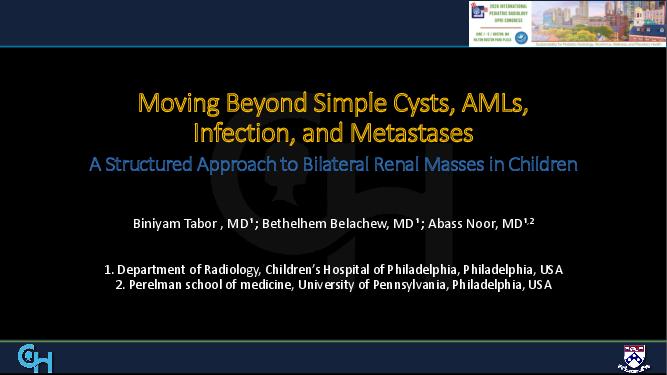
Moving Beyond Simple Cysts, AML, Infection, and Metastases: A Structured Approach to Bilateral Renal Masses in Children
Purpose or Case Report: Bilateral renal masses in children are uncommon but can have stakes. Entities such as nephrogenic rests and nephroblastomatosis, bilateral Wilms tumor (Stage V), hereditary renal cell carcinoma associated with von Hippel Lindau and tuberous sclerosis, DICER1 related cystic neoplasms, and lymphoma often overlap in appearance on imaging. Management pathways can differ widely and can range from surveillance to more aggressive surgical managements. Therefore, radiologists need to integrate imaging findings with clinical and genetic clues to protect renal function and optimize outcomes
This exhibit is designed to help participants recognize multimodality imaging features of uncommon bilateral renal masses beyond simple cysts, angiomyolipomas, infection, and metastases. It also highlights key syndromic associations and epidemiology, including WAGR, Denys Drash, Beckwith Wiedemann, von Hippel Lindau, tuberous sclerosis, and DICER1. Finally, it presents a structured, stepwise framework for refining the differential. It guides recommendations for next steps, such as surveillance, biopsy, or chemotherapy first. The approach emphasizes nephron preservation and close collaboration across the care team.
Methods & Materials: Materials and Methods
- Case-based format integrating US/CT/MRI with concise clinical vignettes.
- Side-by-side image panels highlighting discriminators (location, margins, enhancement, diffusion, multiplicity, symmetry).
- Algorithmic flowchart (detection → imaging discriminators → syndromic flags → management).
- Quick-reference tables: imaging pearls/pitfalls, suggested follow-up intervals, and report phrases.
Results:
Conclusions: A structured multimodality approach improves diagnostic accuracy, reduces unnecessary invasive intervention, and supports nephron-sparing management. Clear, management-oriented reporting strengthens collaboration with oncology, surgery, and genetics.
This exhibit is designed to help participants recognize multimodality imaging features of uncommon bilateral renal masses beyond simple cysts, angiomyolipomas, infection, and metastases. It also highlights key syndromic associations and epidemiology, including WAGR, Denys Drash, Beckwith Wiedemann, von Hippel Lindau, tuberous sclerosis, and DICER1. Finally, it presents a structured, stepwise framework for refining the differential. It guides recommendations for next steps, such as surveillance, biopsy, or chemotherapy first. The approach emphasizes nephron preservation and close collaboration across the care team.
Methods & Materials: Materials and Methods
- Case-based format integrating US/CT/MRI with concise clinical vignettes.
- Side-by-side image panels highlighting discriminators (location, margins, enhancement, diffusion, multiplicity, symmetry).
- Algorithmic flowchart (detection → imaging discriminators → syndromic flags → management).
- Quick-reference tables: imaging pearls/pitfalls, suggested follow-up intervals, and report phrases.
Results:
Conclusions: A structured multimodality approach improves diagnostic accuracy, reduces unnecessary invasive intervention, and supports nephron-sparing management. Clear, management-oriented reporting strengthens collaboration with oncology, surgery, and genetics.
More abstracts on this topic:
A Needs Assessment of Pediatric Neuroradiology Training: Survey of Practicing Pediatric Radiologists
Gokli Ami, Shekdar Karuna, Reid Janet
20 Years of Choosing Wisely in Pediatric Imaging: What We Have LearnedRamirez Suarez Karen, Miranda Schaeubinger Monica, Barton Katherine, Riedesel Erica, Otero Hansel
Poster____EDU-053.pdf
Comments
We encourage you to join the discussion by posting your comments and questions below.
Presenters will be notified of your post so that they can respond as appropriate.
This discussion platform is provided to foster engagement, and stimulate conversation and knowledge sharing.
Please click here to review the full terms and conditions for engaging in the discussion, including refraining from product promotion and non-constructive feedback.
You have to be authorized to post a comment. Please,
Login or
Signup.
Please note that this is a separate login, not connected with your credentials used for the SPR main website.
Rate this abstract
(Maximum characters: 500)
Please note that this is a separate login, not connected with your credentials used for the SPR main website.