Not Available

Society for Pediatric Radiology – Poster Archive
Final ID: Poster #: EDU-018
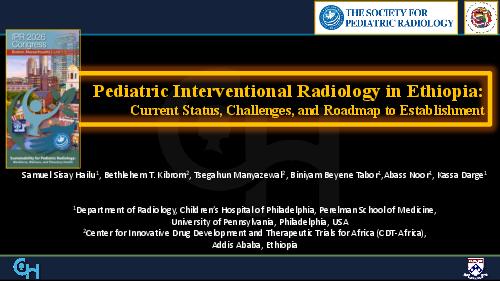
Pediatric Interventional Radiology in Ethiopia: Status, Challenges, and Roadmap to Establishment
Purpose or Case Report: To understand the current state of pediatric IR in Ethiopia, recognize the barriers limiting its establishment, and explore a context-specific roadmap for establishing a sustainable practice that ensures equitable access to minimally invasive care for children in the country.
Ethiopia is the second most populous country in Africa, and 39.1% of the population is between 0 and 14 years of age. Tikur Anbessa Specialized Hospital, Ethiopia’s largest teaching and referral hospital, serves approximately 500,000 patients annually, of whom 48% are children. In 2008, its radiology department partnered with the Children’s Hospital of Philadelphia to establish Ethiopia’s first pediatric radiology fellowship program, which has successfully trained subspecialists and integrated basic image-guided procedures. However, there is currently no established pediatric interventional radiology training program in the country.
Methods & Materials:
Results: Being a highly specialized field in healthcare, pediatric IR encounters unique and substantial challenges in LMICs, including Ethiopia. This includes absence of structured training, lack of infrastructure, equipment, and maintenance, lack of trained professionals, the need for additional unique skills and personnel required in pediatric IR, limited funding, bureaucratic hurdles, lack of healthcare research, including IR, and decreased global focus on IR.
To address these challenges, a phased roadmap toward establishing pediatric IR in Ethiopia is proposed.
Phase 1 (Years 1–2): Preparation — conduct a readiness assessment, strengthen infrastructure, build partnerships, and procure equipment.
Phase 2 (Year 3): Training — leverage Ethiopia’s existing pediatric radiology and adult IR fellowships, supported by international collaborations.
Phase 3 (Year 4): Establishment — graduate the first cohort of pediatric IR specialists and launch services.
Phase 4: Outcome evaluation and capacity building — ensure sustainability through continuous assessment, CME, and international partnerships.
Conclusions: Targeted investment in training, infrastructure, and partnerships can enable Ethiopia to deliver equitable, minimally invasive care for children. Strong leadership and international collaboration are essential for long-term success. The expansion of pediatric IR is important not only for Ethiopia but also for advancing equitable global access to lifesaving innovations.
Ethiopia is the second most populous country in Africa, and 39.1% of the population is between 0 and 14 years of age. Tikur Anbessa Specialized Hospital, Ethiopia’s largest teaching and referral hospital, serves approximately 500,000 patients annually, of whom 48% are children. In 2008, its radiology department partnered with the Children’s Hospital of Philadelphia to establish Ethiopia’s first pediatric radiology fellowship program, which has successfully trained subspecialists and integrated basic image-guided procedures. However, there is currently no established pediatric interventional radiology training program in the country.
Methods & Materials:
Results: Being a highly specialized field in healthcare, pediatric IR encounters unique and substantial challenges in LMICs, including Ethiopia. This includes absence of structured training, lack of infrastructure, equipment, and maintenance, lack of trained professionals, the need for additional unique skills and personnel required in pediatric IR, limited funding, bureaucratic hurdles, lack of healthcare research, including IR, and decreased global focus on IR.
To address these challenges, a phased roadmap toward establishing pediatric IR in Ethiopia is proposed.
Phase 1 (Years 1–2): Preparation — conduct a readiness assessment, strengthen infrastructure, build partnerships, and procure equipment.
Phase 2 (Year 3): Training — leverage Ethiopia’s existing pediatric radiology and adult IR fellowships, supported by international collaborations.
Phase 3 (Year 4): Establishment — graduate the first cohort of pediatric IR specialists and launch services.
Phase 4: Outcome evaluation and capacity building — ensure sustainability through continuous assessment, CME, and international partnerships.
Conclusions: Targeted investment in training, infrastructure, and partnerships can enable Ethiopia to deliver equitable, minimally invasive care for children. Strong leadership and international collaboration are essential for long-term success. The expansion of pediatric IR is important not only for Ethiopia but also for advancing equitable global access to lifesaving innovations.
More abstracts on this topic:
Trends in Female Representation in Diagnostic Radiology and Pediatric Radiology
Mousa Abeer, Simmons Curtis
Posttreatment Imaging Assessment After Locoregional Liver Therapy in the Pediatric Interventional Oncology Patient: A Multi-center Case-based OverviewTang Elizabeth, Zavaletta Vaz, Acord Michael, Escobar Fernando, Monroe Eric, Gill Anne
Poster____EDU-018.pdf
Comments
We encourage you to join the discussion by posting your comments and questions below.
Presenters will be notified of your post so that they can respond as appropriate.
This discussion platform is provided to foster engagement, and stimulate conversation and knowledge sharing.
Please click here to review the full terms and conditions for engaging in the discussion, including refraining from product promotion and non-constructive feedback.
You have to be authorized to post a comment. Please,
Login or
Signup.
Please note that this is a separate login, not connected with your credentials used for the SPR main website.
Rate this abstract
(Maximum characters: 500)
Please note that this is a separate login, not connected with your credentials used for the SPR main website.