Not Available


Society for Pediatric Radiology – Poster Archive
Final ID: Poster #: SCI-006
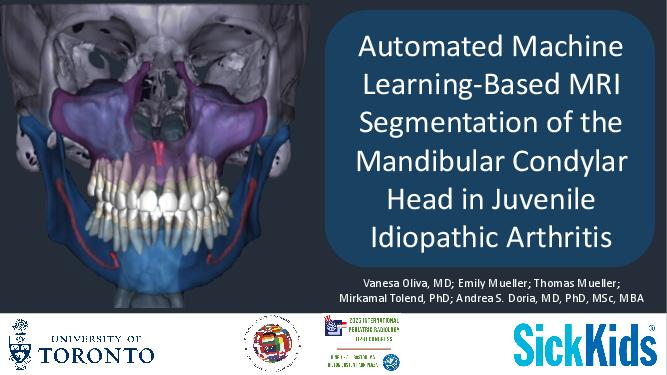
Automated Machine Learning-based MRI Segmentation of the Mandibular Condylar Head in Juvenile Idiopathic Arthritis
Purpose or Case Report: Temporomandibular joint (TMJ) is involved in approximately 40% of children with juvenile idiopathic arthritis (JIA), but its involvement can be silent, without obvious clinical findings. Contrast-enhanced MRI is therefore key for diagnosis and follow-up of patients, remaining the diagnostic gold standard, as it is able to evaluate both inflammatory and osteochondral changes. Improving the quantitative evaluation of mandibular condylar morphology and radiomic features on MRI has immense practical utility for clinical management decisions in JIA. In this study we evaluated the potential of automated machine learning-based segmentation of the condylar head when applied to routinely acquired TMJ MRI exams.
Methods & Materials: Bilateral condyles from 62 retrospectively curated TMJ MRI exams were manually segmented, extending inferiorly to a landmark plane defining the condylar head, which ran perpendicularly from the sigmoid notch to a plane tangential to the posterior aspect of the condylar ramus. A sagittal-oblique proton-density-weighted sequence was used. The segmentation masks were individually reviewed and approved by a radiologist, with escalation of uncertain cases to consensus with a senior MSK radiologist. These masks were used to train a segmentation model using the nnU-net v2 architecture. Validation testing was performed by a 5-by-5 nested cross validation workflow, using ensemble inference on the held-out sets.
Results: Our cohort consisted of 47 JIA patients (79% female), aged 3-18 years (median age 13, interquartile range [IQR] 8-14). The segmentation model achieved a median Dice similarity coefficient of 0.86 (IQR: 0.81-0.89, Range: 0.54-0.92; mean 0.84+/-0.07SD) on the held-out sets. Median precision was 0.90 (IQR: 0.84-0.93), and recall was 0.84 (IQR: 0.78-0.89), indicating the model’s slight conservative tendency to under-segment.
Conclusions: Our study demonstrated the feasibility of using an automated segmentation model from routine TMJ MRIs with acceptable performance. Our study findings support future quantitative TMJ research in the JIA population, facilitating the quantitative study of morphometric changes between and within-patients over time, and helping improve diagnostic and outcome measure research in TMJ arthritis. Such results open avenues for short-term clinical translation of findings to daily practice on the decision making process of starting or changing therapy.
Methods & Materials: Bilateral condyles from 62 retrospectively curated TMJ MRI exams were manually segmented, extending inferiorly to a landmark plane defining the condylar head, which ran perpendicularly from the sigmoid notch to a plane tangential to the posterior aspect of the condylar ramus. A sagittal-oblique proton-density-weighted sequence was used. The segmentation masks were individually reviewed and approved by a radiologist, with escalation of uncertain cases to consensus with a senior MSK radiologist. These masks were used to train a segmentation model using the nnU-net v2 architecture. Validation testing was performed by a 5-by-5 nested cross validation workflow, using ensemble inference on the held-out sets.
Results: Our cohort consisted of 47 JIA patients (79% female), aged 3-18 years (median age 13, interquartile range [IQR] 8-14). The segmentation model achieved a median Dice similarity coefficient of 0.86 (IQR: 0.81-0.89, Range: 0.54-0.92; mean 0.84+/-0.07SD) on the held-out sets. Median precision was 0.90 (IQR: 0.84-0.93), and recall was 0.84 (IQR: 0.78-0.89), indicating the model’s slight conservative tendency to under-segment.
Conclusions: Our study demonstrated the feasibility of using an automated segmentation model from routine TMJ MRIs with acceptable performance. Our study findings support future quantitative TMJ research in the JIA population, facilitating the quantitative study of morphometric changes between and within-patients over time, and helping improve diagnostic and outcome measure research in TMJ arthritis. Such results open avenues for short-term clinical translation of findings to daily practice on the decision making process of starting or changing therapy.
More abstracts on this topic:
Evaluation of a Comprehensive Approach to Prepare Pediatric Patients for MRI
Vleuten-chraibi Sanae, Nauts Sanne
CT Findings of Baseline and Metastatic Desmoplastic Small Round Cell Tumors: A Single Institute ExperienceBaheti Akshay, Bhaladhare Prachi, Patil Vasundhara, Gala Kunal, Shetty Nitin, Kulkarni Suyash, Ramadwar Mukta, Panjawani Poonam, Qureshi Sajid
Poster____SCI-006.pdf
Comments
We encourage you to join the discussion by posting your comments and questions below.
Presenters will be notified of your post so that they can respond as appropriate.
This discussion platform is provided to foster engagement, and stimulate conversation and knowledge sharing.
Please click here to review the full terms and conditions for engaging in the discussion, including refraining from product promotion and non-constructive feedback.
You have to be authorized to post a comment. Please,
Login or
Signup.
Please note that this is a separate login, not connected with your credentials used for the SPR main website.
Rate this abstract
(Maximum characters: 500)
Please note that this is a separate login, not connected with your credentials used for the SPR main website.