Not Available


Society for Pediatric Radiology – Poster Archive
Final ID: Poster #: SCI-020
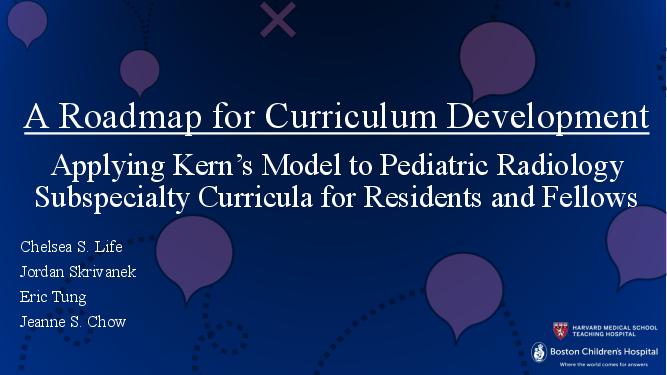
A Roadmap for Curriculum Development: Applying Kern’s Model to Pediatric Radiology Subspecialty Curricula for Residents and Fellows
Purpose or Case Report: To develop a reproducible framework for designing subspecialty pediatric radiology curricula.
Methods & Materials: Kern’s 6-step model for curriculum development was implemented while creating a pediatric radiology genitourinary (GU) curriculum to serve as a template for successive curricula at an academic pediatric hospital. Our steps included: 1. Problem identification: evaluating institutional resources and performing a literature search; 2. Local needs assessment: surveying trainees regarding their perception of curriculum accessibility and clarity using a standardized Likert scale; 3. Creation of clear goals: designing learning objectives based on input from experts in pediatric GU imaging and national curriculum standards set by the American Board of Radiology and Society of Pediatric Radiology; 4. Educational strategy: integrating curated resources; 5. Implementation: piloting the curriculum with learners; and 6. Evaluation/feedback: surveying learners to determine impact.
Results: Review of institutional resources and a literature search demonstrated the lack of an organized pediatric GU radiology curriculum. The needs assessment of current fellows and residents (n=13) revealed that 38.5% of trainees are not confident in which GU topics are important to study to be successful in their training. Furthermore, 61.6% do not know what resources they should use to optimize their learning. The majority of trainees do not think that they have a clear structure to guide their studying (77.0%), nor do they believe that they study pediatric GU imaging in a systematic manner (77.0%). Based on these findings, a curriculum was developed utilizing national guidelines and feedback from four pediatric GU radiologists. The curriculum was constructed with clear learning objectives and divided into two tiers of complexity to meet the distinct needs of residents and fellows. This design was reviewed at a departmental quality improvement meeting for additional feedback. Future steps include: matching curated resources to the learning objectives that they satisfy, implementing the curriculum using a unified platform, and surveying the perception of the new curriculum in its effectiveness to guide self-directed learning.
Conclusions: We applied Kern’s 6-Step method of curriculum development to create a pediatric radiology GU curriculum for residents and fellows at our institution. This roadmap outlines a feasible, reproducible framework to address the critical need for standardization in pediatric radiology training.
Methods & Materials: Kern’s 6-step model for curriculum development was implemented while creating a pediatric radiology genitourinary (GU) curriculum to serve as a template for successive curricula at an academic pediatric hospital. Our steps included: 1. Problem identification: evaluating institutional resources and performing a literature search; 2. Local needs assessment: surveying trainees regarding their perception of curriculum accessibility and clarity using a standardized Likert scale; 3. Creation of clear goals: designing learning objectives based on input from experts in pediatric GU imaging and national curriculum standards set by the American Board of Radiology and Society of Pediatric Radiology; 4. Educational strategy: integrating curated resources; 5. Implementation: piloting the curriculum with learners; and 6. Evaluation/feedback: surveying learners to determine impact.
Results: Review of institutional resources and a literature search demonstrated the lack of an organized pediatric GU radiology curriculum. The needs assessment of current fellows and residents (n=13) revealed that 38.5% of trainees are not confident in which GU topics are important to study to be successful in their training. Furthermore, 61.6% do not know what resources they should use to optimize their learning. The majority of trainees do not think that they have a clear structure to guide their studying (77.0%), nor do they believe that they study pediatric GU imaging in a systematic manner (77.0%). Based on these findings, a curriculum was developed utilizing national guidelines and feedback from four pediatric GU radiologists. The curriculum was constructed with clear learning objectives and divided into two tiers of complexity to meet the distinct needs of residents and fellows. This design was reviewed at a departmental quality improvement meeting for additional feedback. Future steps include: matching curated resources to the learning objectives that they satisfy, implementing the curriculum using a unified platform, and surveying the perception of the new curriculum in its effectiveness to guide self-directed learning.
Conclusions: We applied Kern’s 6-Step method of curriculum development to create a pediatric radiology GU curriculum for residents and fellows at our institution. This roadmap outlines a feasible, reproducible framework to address the critical need for standardization in pediatric radiology training.
More abstracts on this topic:
Evaluating WhatsApp as a Teaching Tool for Pediatric Radiology in East Africa
Rooks Elizabeth, Rousslang Lee, Meldrum Jaren, Ishikawa Kyle, Chen John, Rousslang Nikki, Nayiga Joyce, Destigter Kristen
Effectiveness of a New Curriculum Designed to Teach Residents and Fellows the use of Ultrasound in the Diagnosis of Midgut VolvulusNguyen Haithuy, Mehollin-ray Amy, Sammer Marla
Poster____SCI-020.pdf
Comments
We encourage you to join the discussion by posting your comments and questions below.
Presenters will be notified of your post so that they can respond as appropriate.
This discussion platform is provided to foster engagement, and stimulate conversation and knowledge sharing.
Please click here to review the full terms and conditions for engaging in the discussion, including refraining from product promotion and non-constructive feedback.
You have to be authorized to post a comment. Please,
Login or
Signup.
Please note that this is a separate login, not connected with your credentials used for the SPR main website.
Rate this abstract
(Maximum characters: 500)
Please note that this is a separate login, not connected with your credentials used for the SPR main website.