Not Available


Society for Pediatric Radiology – Poster Archive
Final ID: Poster #: SCI-065
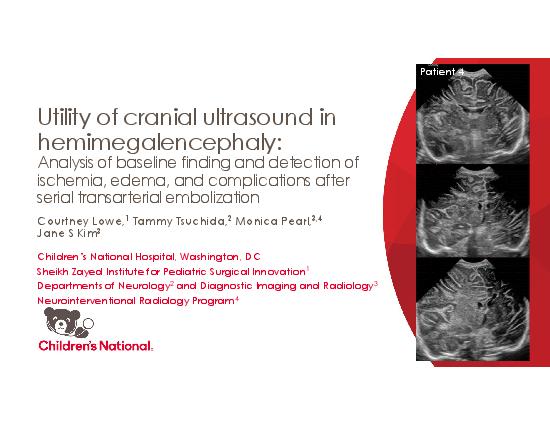
Utility of Cranial Ultrasound in Hemimegalencephaly: Analysis of Baseline Findings and Detection of Ischemia, Edema and Complications After Serial Transarterial Embolization
Purpose or Case Report: Hemimegalencephaly (HME) is a rare cortical brain malformation often resulting in medically refractory seizures which may be treated with staged transarterial embolization (TAE) as an alternative to hemispherectomy. We describe the baseline cranial ultrasound findings of 8 HME patients and present the timing of detection of ischemic changes, edema, and complications.
Methods & Materials: HME infants treated with serial TAE for refractory seizures with baseline ultrasound imaging were included. Serial ultrasound studies were performed on the day of each staged procedure then daily for 3 days. Ultrasound studies were retrospectively reviewed to define baseline findings and to detect ischemic change, progression of edema, and complications after each procedure.
Results: Eight HME infants (average age <2 months; 4 males, 4 females) with refractory seizures were treated with serial TAE from 2011-2024. Baseline ultrasound showed 5 right and 3 left enlarged hemispheres and 2 with cerebellar involvement. Abnormal echogenicity was detected in the white matter (75%) and thalamus (50%), in addition to cortical thickening (88%), unilateral ventricular enlargement (63%), midline shift (88%) and lenticulostriate vasculopathy (50%). One patient had a ventricular shunt placed prior to treatment. Over the course of staged TAE, ischemic changes were detected on average 3.1 days after stage 1, 2.7 days after stage 2, and 1.6 days after stage 3 (n=8). In patients whose treatment included a stage 4 (n=4), ischemic change appeared within 1 day; none were seen within 3 days after stage 5 (n=1). On average, peak edema was observed at 15.7 days and cystic changes at 37.3 days after the first embolization. Detected complications and adverse events included intraventricular hemorrhage (1), subarachnoid hemorrhage (3), non-target embolization (2), and ventriculomegaly requiring a shunt (1).
Conclusions: Most HME patients demonstrated baseline ultrasound findings of unilateral hemispheric enlargement without cerebellar involvement, abnormal white matter echogenicity, cortical thickening, unilateral ventricular enlargement and midline shift. Following stage 1 embolization, the average time to ischemic detection was 3 days which progressively decreased with later stages, likely due to compounding injury with fewer collaterals to maintain perfusion. Knowing the expected progression of ischemic change, edema, and potential complications visualized on ultrasound can help guide management of HME patients undergoing serial TAE.
Methods & Materials: HME infants treated with serial TAE for refractory seizures with baseline ultrasound imaging were included. Serial ultrasound studies were performed on the day of each staged procedure then daily for 3 days. Ultrasound studies were retrospectively reviewed to define baseline findings and to detect ischemic change, progression of edema, and complications after each procedure.
Results: Eight HME infants (average age <2 months; 4 males, 4 females) with refractory seizures were treated with serial TAE from 2011-2024. Baseline ultrasound showed 5 right and 3 left enlarged hemispheres and 2 with cerebellar involvement. Abnormal echogenicity was detected in the white matter (75%) and thalamus (50%), in addition to cortical thickening (88%), unilateral ventricular enlargement (63%), midline shift (88%) and lenticulostriate vasculopathy (50%). One patient had a ventricular shunt placed prior to treatment. Over the course of staged TAE, ischemic changes were detected on average 3.1 days after stage 1, 2.7 days after stage 2, and 1.6 days after stage 3 (n=8). In patients whose treatment included a stage 4 (n=4), ischemic change appeared within 1 day; none were seen within 3 days after stage 5 (n=1). On average, peak edema was observed at 15.7 days and cystic changes at 37.3 days after the first embolization. Detected complications and adverse events included intraventricular hemorrhage (1), subarachnoid hemorrhage (3), non-target embolization (2), and ventriculomegaly requiring a shunt (1).
Conclusions: Most HME patients demonstrated baseline ultrasound findings of unilateral hemispheric enlargement without cerebellar involvement, abnormal white matter echogenicity, cortical thickening, unilateral ventricular enlargement and midline shift. Following stage 1 embolization, the average time to ischemic detection was 3 days which progressively decreased with later stages, likely due to compounding injury with fewer collaterals to maintain perfusion. Knowing the expected progression of ischemic change, edema, and potential complications visualized on ultrasound can help guide management of HME patients undergoing serial TAE.
More abstracts on this topic:
Antenatal US and MR features of Congenital High Airway Obstruction Sequence (CHAOS)
El Hawari Mohamad, Joshi Akash, Zarchan Adam, Dobbs-desilet Debbie, Ornelas Samuel
A Rare Case of a Twin Molar Pregnancy Featuring a Complete Hydatidiform Mole and a Coexisting Live FetusElcic Lana, Nashawaty Motassem, Mousa Abeer, Wermers Joshua
Poster____SCI-065.pdf
Comments
We encourage you to join the discussion by posting your comments and questions below.
Presenters will be notified of your post so that they can respond as appropriate.
This discussion platform is provided to foster engagement, and stimulate conversation and knowledge sharing.
Please click here to review the full terms and conditions for engaging in the discussion, including refraining from product promotion and non-constructive feedback.
You have to be authorized to post a comment. Please,
Login or
Signup.
Please note that this is a separate login, not connected with your credentials used for the SPR main website.
Rate this abstract
(Maximum characters: 500)
Please note that this is a separate login, not connected with your credentials used for the SPR main website.